B2B marketing agencies are specialist firms that plan, execute, and optimize marketing programs for companies selling to other businesses. In 2026, they matter more than ever. The rise of AI search channels, longer buying cycles stretching 6-18 months, and buying committees of 6-10+ stakeholders have made B2B marketing significantly more complex than running a few LinkedIn ads and hoping for the best.
Discover the unique offerings of these industry-leading B2B agencies and learn how to maximize your ROI by vetting a B2B marketing agency to execute a profitable B2B digital marketing strategy that drives consistent and recurring revenue growth.
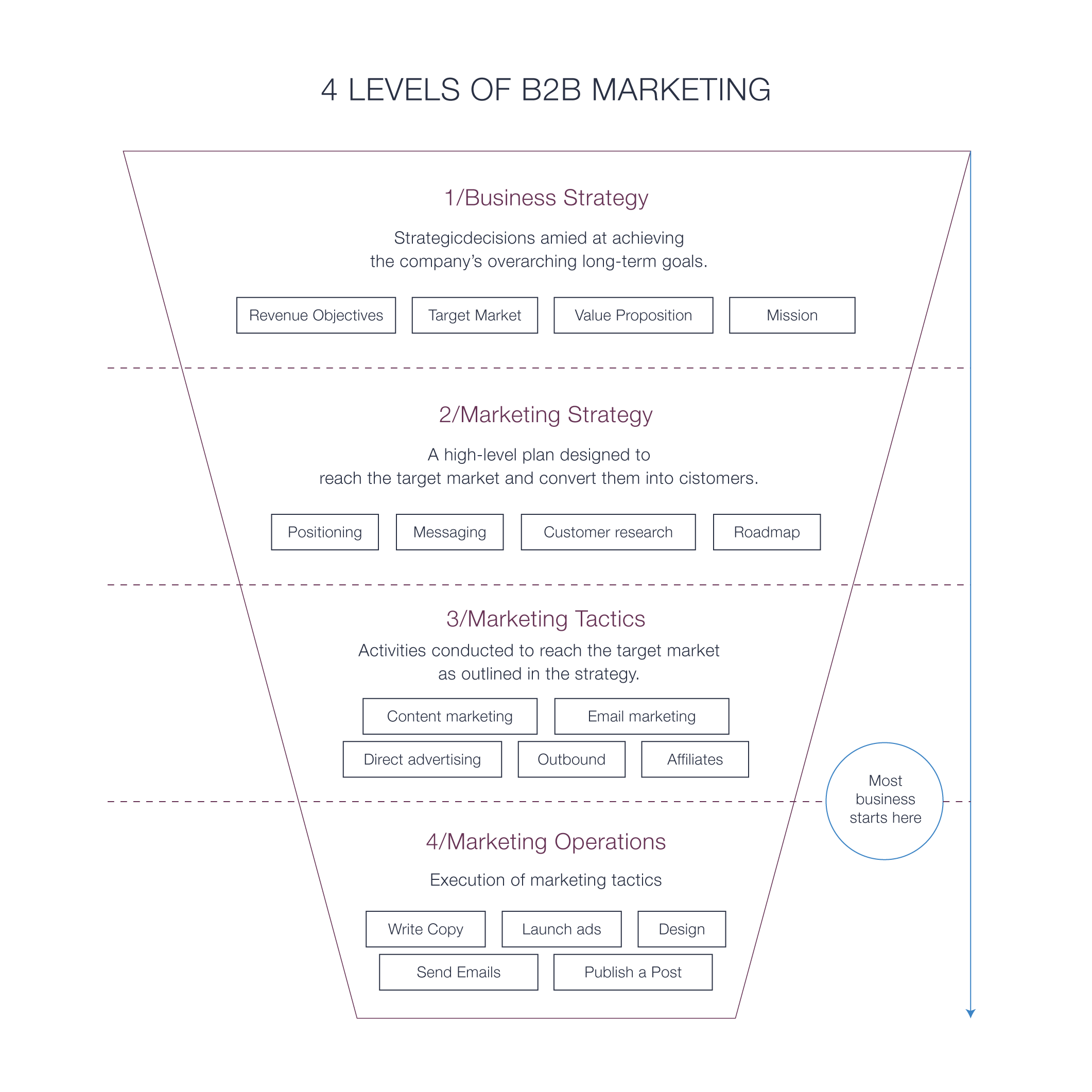
This article answers the questions you’re likely asking: What do B2B marketing agencies actually do? Which services matter for your business? How do you choose the right agency partner? And what should you realistically expect from the relationship?
Between 2024 and 2026, companies have demonstrably shifted marketing budgets from purely in-house teams to agency partnerships, driven by rising media costs, talent shortages, and the complexity of managing multiple new channels simultaneously. Leading B2B marketing agencies are increasingly focused on addressing enterprise needs, offering scalable solutions and ensuring alignment with the strategic goals of large organizations. The emergence of Answer Engine Optimization for AI search represents just one of many shifts agencies now navigate daily.
This buyer’s guide is written from the perspective of a specialist B2B marketing agency speaking directly to CMOs, VPs of Marketing, and founders. We’ll cover how modern agencies operate, the key capabilities that separate great partners from order-takers, concrete selection criteria, and how to structure a productive working relationship. Whether you’re evaluating your first agency partnership or reconsidering your current approach, you’ll walk away with a clear framework for making this decision.
What Is a B2B Marketing Agency In 2026?
A B2B marketing agency is a professional services firm that plans, executes, and optimizes marketing specifically for companies whose customers are other businesses. The core distinction from B2C shops centers on structural differences that fundamentally change how marketing works.
Modern B2B agencies differ from B2C agencies in several critical ways. B2B sales cycles run 6-18 months for enterprise SaaS, manufacturing, and industrial software deals, compared to B2C cycles measured in days. Buying committees of 6-10+ stakeholders influence or make purchase decisions, each with different priorities. Products are often technically sophisticated and require translation into business value across multiple audiences rather than simple consumer benefits.
Typical engagement models in 2025-2026 include monthly retainers (ranging from $6,000 to $50,000+ depending on scope), project-based sprints for specific initiatives like product launches or market entries, and emerging revenue-based partnerships where agency compensation ties directly to pipeline created. Most agencies prefer hybrid structures: a base retainer for core activities plus project fees for specialized work.
Concrete deliverables from B2B agencies span ABM campaigns targeting high-value accounts, full-funnel demand generation programs, B2B SEO strategy, content engines producing thought leadership and case studies, website optimization, and marketing services including MarTech stack management.
Main types of B2B marketing agencies:
- Full-funnel agencies: Handle brand positioning, creative services, content production, paid media, and web development under one roof
- Creative and brand agencies: Focus on brand strategy, messaging, and visual identity
- Performance marketing agencies: Specialize in paid media, demand generation, and measurable outcomes
- Content-led agencies: Excel at thought leadership, SEO, and content marketing programs
Understanding Demand Generation in B2B Marketing
Demand generation is at the heart of modern B2B marketing, serving as the engine that fuels pipeline growth and business expansion. Unlike traditional lead generation, which focuses solely on capturing contact information, demand generation encompasses the entire process of creating awareness, nurturing interest, and guiding potential customers through the buyer’s journey until they are ready to engage with sales.
Effective demand generation strategies blend content marketing, performance marketing, and targeted lead generation to reach and engage the right audience at every stage. This requires a deep understanding of your target audience’s pain points, decision-making criteria, and preferred channels. By leveraging data-driven insights, B2B marketers can craft bespoke strategies that deliver personalized experiences for key decision makers, ensuring that every touchpoint moves prospects closer to conversion.
The most successful demand generation programs are built on continuous optimization. Marketers analyze campaign data to identify what resonates with their audience, refine messaging, and allocate resources to the highest-performing tactics. This approach not only drives measurable outcomes, such as increased qualified leads and accelerated pipeline growth, but also supports real growth by aligning marketing efforts with business objectives.
In today’s competitive landscape, demand generation is more than a set of tactics; it’s a holistic approach that empowers marketers to build lasting relationships with customers, deliver value at every stage, and achieve sustainable business growth.
Types of Marketing Agencies: Which Is Right for You?
Choosing the right marketing agency is a pivotal decision that can shape your company’s trajectory. With a wide array of marketing agencies offering diverse service offerings, it’s essential to match your business needs with the agency’s strengths and focus.
Full-service agencies provide end-to-end solutions, covering everything from brand strategy and content creation to performance marketing and analytics. These agencies are ideal for businesses seeking a single partner to manage integrated campaigns and ensure consistency across all marketing channels.
Specialist agencies focus on specific disciplines such as SEO strategy, content marketing, or paid media. If your business has a well-defined need, like boosting organic visibility or scaling content production, a specialist agency with deep expertise in that area can deliver targeted results.
When evaluating agencies, consider their industry experience, the breadth and depth of their service offerings, and their collaborative approach. The best agency partners take the time to understand your business goals, tailor their strategies to your unique challenges, and work closely with your internal team to drive sustainable growth.
Ultimately, the right agency is one whose expertise, focus, and approach align with your strategy and business objectives, enabling you to achieve measurable results and long-term success.
Top 10 B2B Marketing Agencies in the U.S.
Let's dive into the world of these top-notch U.S. based B2B marketing agencies and explore what sets them apart. Review key offerings, pros and cons, notable clients and case study examples.
1. 310 Creative
Company Overview:
310 Creative is a B2B marketing agency with a demand generation specialty founded in 2003 and headquartered in Santa Monica, California. The agency focuses on helping B2B technology companies, professional services, manufacturing, and media brands build predictable and repeatable streams of leads, customers, and revenue through inbound marketing and account-based marketing campaigns. Over two decades it has operated as an extension of client marketing teams, emphasizing revenue growth strategies and demand generation programs designed to scale customer acquisition and improve marketing ROI. 310 Creative has also been recognized as a Diamond HubSpot Partner in 2021, an indication of its expertise with the HubSpot growth platform and inbound methodologies.
Methodology & Services:
The agency’s methodology centers on full-funnel inbound marketing, account-based marketing (ABM), and revenue operations support that helps businesses generate qualified leads and turn them into customers. Core service offerings include inbound strategy and execution, persona-driven content marketing, SEO and search visibility, marketing automation and conversion funnel optimization, outbound account outreach, CRM implementation and optimization, and sales enablement assets. 310 Creative also provides growth-driven website design and optimization to improve conversion rates and support scalable demand generation campaigns. The agency positions its approach around aligning marketing efforts with the modern buyer’s journey and making sales handoffs smoother to ultimately increase revenue impact.
Market Position & Brand Perception:
310 Creative positions itself as a strategic growth partner for B2B companies that need inbound and demand generation support complemented by sales alignment. Its Platinum status within the HubSpot Agency Partner Program and industry recognition (such as historical rankings among top HubSpot partners) highlight its credibility in the inbound marketing space. Client testimonials emphasize responsiveness, collaboration, and positive impacts on HubSpot ROI, lead generation, and website performance. Potential clients, however, should assess agency fit based on engagement scope, budget, and specific growth objectives since results can vary by project.
Pros & Cons
Pros:
-
Established B2B demand generation agency with 20+ years of B2B marketing experience (since 2003).
-
Platinum HubSpot Partner status, affirming advanced platform expertise and advanced go-to-market capabilities.
-
Comprehensive service suite covering inbound marketing, account-based marketing, sales enablement, conversion optimization and CRM support.
-
Positive client testimonials citing responsiveness, collaboration, improved HubSpot ROI, and conversion performance.
Cons:
-
Agency’s focus on inbound and account-based marketing is a more sophisticated offering suite, not suitable for companies looking for traditional marketing services like PPC and SEO.
-
Engagement scopes and pricing start at $4,000 per month according to their pricing page, which can make their services not suitable for startups.
-
Experience and results likely vary by project scope, typical for agencies, underscoring the need for careful scoping and goal alignment.
2. Directive Consulting
Company Overview:
Directive Consulting (often branded simply as Directive) is a B2B performance marketing agency that helps technology, SaaS, and other business-to-business companies grow qualified pipeline and revenue, not just traditional marketing metrics like clicks or MQLs. Founded in 2014 and headquartered in Irvine, California, Directive has served more than 420 brands globally and claims to have generated over $1 billion in client revenue through its work with mid-market and enterprise clients. The agency operates with a global team across North America, EMEA, and APAC, positioning itself as a strategic partner that embeds with internal teams for long-term growth outcomes rather than acting as a disconnected vendor.
Methodology & Services:
At the core of Directive’s approach is its Customer Generation methodology, which aligns every channel and tactic to business outcomes like pipeline, customer acquisition cost (CAC), and revenue, instead of vanity metrics. Its service portfolio includes paid media management (PPC across Google, LinkedIn, etc.), full-funnel content marketing and SEO, conversion rate optimization (CRO) and performance design, revenue operations and reporting, account-based marketing (ABM), creative strategy, and go-to-market planning. The agency emphasizes data-driven strategy, financial modeling and first-party intent signals, measuring performance in terms stakeholders understand, like SQLs and revenue contribution.
Market Position & Brand Perception:
Directive positions itself as a strategic growth partner for ambitious B2B and SaaS organizations that need deep analytics, pipeline optimization, and measurable impact. Independent industry directories rate the agency highly for its comprehensive service suite and clear ties to revenue outcomes, though pricing isn’t published publicly, which means prospective clients often must engage directly for detailed proposals. Directive is typically best suited to mid-size and enterprise B2B clients rather than small businesses with simpler needs or limited budgets.
Pros & Cons
Pros:
-
Outcome-oriented methodology: Emphasis on pipeline, SQLs, CAC, and revenue, not vanity metrics.
-
Comprehensive B2B service suite: Paid media, SEO, content, CRO, RevOps, ABM, and go-to-market strategy under one roof.
-
Proven track record: Claims over $1 B in client revenue and experience with hundreds of brands globally.
-
Data-driven and strategic: Strong emphasis on financial modeling, intent signals, and measurable performance dashboards.
Cons:
-
Pricing not publicly listed: Budgeting requires consultation and scope clarification.
-
Premium and complex services: Best suited to mid-market and enterprise clients rather than smaller businesses.
-
Broad service scope: The depth and breadth of offerings may require multiple discovery sessions to map exact deliverables.
3. New North
Company Overview:
New North is a B2B marketing agency for technology companies that helps small to mid-sized tech marketing teams generate leads, increase engagement, and drive growth through strategic digital marketing and execution. Founded in 2008 and headquartered in Frederick Maryland, New North emphasizes transparency and partnership with clients by providing ongoing visibility into work progress through client portals and custom reporting. Their team works closely with clients as an extension of internal marketing resources to ensure alignment between strategy and execution.
Methodology & Services:
New North’s methodology centers on creating tailored and data-driven marketing programs that align with client objectives and deliver measurable outcomes. Its core services include account-based marketing (ABM) designed to reach key decision-makers in target accounts, content creation such as blogs, podcasts, videos and case studies that engage audiences, paid media campaigns including PPC and social advertising, and reporting and analytics that connect performance data across channels. Additional service lines include branding and positioning, website development and design, marketing operations support, and sales enablement.
Market Position & Brand Perception:
New North positions itself as a strategic partner for B2B technology companies that need both strategy and tactical execution to scale growth. The agency is recognized for its close collaborations with clients and strong emphasis on data and analytics to drive decisions. Independent profiles show positive client perceptions and reviews, and the company has been featured in industry lists for effective digital marketing service delivery. Pricing is generally presented with transparency principles like using “points not hours” to align cost with deliverables.
Pros & Cons
Pros:
-
Focused on B2B technology marketing with tailored strategies for niche audiences.
-
Comprehensive mix of services including ABM, content, paid media, reporting, and design.
-
Emphasis on transparency and client access to project status and results.
-
Strong independent reviews and client testimonials indicating satisfaction and results.
Cons:
-
Minimum project budgets and retainer levels may be higher than what very small businesses typically choose.
-
Service focus heavily oriented toward technology B2B, which may limit fit for non-tech businesses.
-
Detailed pricing and scope often require consultation and discovery before engagement.
4. Ironpaper
Company Overview:
Ironpaper is a B2B marketing and digital growth agency based in New York City with additional presence in Charlotte, North Carolina. Founded in 2002, Ironpaper focuses exclusively on helping business-to-business companies with long or complex sales cycles improve lead generation, sales engagement, conversion rates, and revenue growth. The agency’s team integrates strategy, creative services, technology, and analytics to support measurable outcomes and align marketing with sales activities for sustained pipeline performance.
Methodology & Services:
Ironpaper’s approach centers on building integrated B2B growth programs that are data-driven and optimized for the buyer’s journey. Core services include demand generation, account-based marketing (ABM), inbound marketing, content strategy and creation, sales enablement, lead nurturing, marketing automation, websites and UX design, digital advertising and PPC, SEO, conversion optimization, and analytics. The agency emphasizes ongoing measurement, iterative optimization, and alignment of marketing with sales to ensure campaigns contribute directly to qualified lead growth and pipeline acceleration.
Market Position & Brand Perception:
Ironpaper positions itself as a strategic partner for B2B companies that need more than tactical execution, with an emphasis on measurable results and long-term growth. Its specialization in B2B marketing and demand generation for technology, SaaS, professional services, and other business markets distinguishes it from generalist agencies. Independent profiles highlight its capability to function as an extension of internal teams and its expertise in integrating digital strategy with execution. Engagements typically involve custom, retainer-based arrangements and are best suited for organizations that require a full-funnel growth engine rather than isolated marketing tasks.
Pros & Cons
Pros:
-
Focus on measurable B2B outcomes such as qualified leads, conversion rates, and opportunity pipeline growth.
-
Wide range of integrated services including demand generation, ABM, content, websites, and sales enablement.
-
Experience with complex B2B sales processes and alignment of marketing with sales.
-
Long operational history since 2002 and experience with mid-size to enterprise clients.
Cons:
-
Pricing is generally positioned toward mid-market and larger clients rather than small businesses, often requiring custom proposals.
-
Engagements are typically comprehensive and higher touch, which can require more internal coordination and investment.
-
Agency focus on B2B means limited applicability for B2C-oriented companies.
5. Omniscient
Company Overview:
Omniscient Digital is a B2B organic growth agency based in Austin, Texas, that helps software and technology companies grow qualified leads, pipeline, and revenue through search engine optimization (SEO), generative search optimization (GEO), and content programs. Founded in 2019, the agency focuses on turning SEO and content into durable inbound growth channels rather than merely increasing traffic. Its leadership team includes marketers who previously led growth and editorial functions at major B2B platforms, and the agency works with clients ranging from startups to well-known technology brands.
Methodology & Services:
Omniscient Digital’s methodology centers on building sustainable organic growth programs rooted in research, strategy, execution, and analytics. Engagements typically begin with deep research into the client’s product, competitors, and industry to inform a tailored SEO and content strategy. Core services include SEO and content strategy development, high-quality content creation (long-form blogs, guides, white papers), technical SEO, link building and digital PR, digital marketing analytics and reporting, and optimization for AI and LLM search visibility. The agency emphasizes authority building and positioning brands as trusted leaders across search and AI surfaces, with reporting tied to business outcomes like qualified leads, pipeline influence, and revenue impact.
Market Position & Brand Perception:
Omniscient Digital positions itself as a strategic partner for B2B SaaS and technology marketing teams that want to develop a comprehensive organic growth engine anchored in content and SEO. Independent profiles and client case studies highlight significant performance improvements such as large increases in organic sessions, conversions, and pipeline attributable to organic efforts. The agency is often featured in industry lists for organic growth and SaaS content agencies, and it is known for its focus on quality and measurable results rather than output volume. Pricing and scope are generally tailored to client needs, with full-service engagements beginning at professional retainer levels.
Pros & Cons
Pros:
-
Focus on business outcomes such as qualified leads, pipeline growth, and revenue rather than vanity metrics.
-
Integrated organic growth methodology including SEO, content, link building, and analytics tied to measurable results.
-
Expertise in optimizing for modern search environments, including AI and LLM visibility.
-
Track record of driving significant organic performance improvements for B2B software brands.
Cons:
-
Specialized focus on organic growth and B2B software means it may not be suitable for companies needing broad marketing services like paid media or email campaigns.
-
Engagement cost and scope can require consultation and custom proposals rather than published pricing.
-
Creative output is primarily content and SEO focused, which may not fulfill every digital marketing need for some organizations.
Let me know if you would like a comparison of Omniscient Digital with other organic growth or SEO agencies.
6. LabsMedia
.png?width=1500&height=605&name=labsmedia%20(1).png)
Company Overview:
LabsMedia is a SaaS marketing agency that helps software as a service companies and technology-driven businesses grow by increasing qualified leads, boosting revenue, and improving user acquisition and retention. Based in Brampton, Ontario with a team of marketing professionals, the agency positions itself as a strategic partner that delivers tailored marketing solutions designed specifically for the SaaS industry. Its mission is to empower SaaS brands to compete effectively in the digital marketplace through data-driven strategies and execution.
Methodology & Services:
LabsMedia’s methodology focuses on comprehensive SaaS growth programs that integrate strategy, analytics, and execution to drive measurable business results. Core services offered include SaaS marketing strategy, search engine optimization (SEO), off-page link building, content creation, pay-per-click (PPC) advertising, digital marketing campaigns, website design and development, WordPress development and maintenance, and other support functions aimed at improving visibility, conversion, and revenue. The agency emphasizes customized approaches tailored to each client’s goals and market position.
Market Position & Brand Perception:
LabsMedia positions itself as a specialized growth partner for SaaS companies rather than a generalist digital marketing firm, with a deep focus on outcomes that matter to SaaS leaders such as MRR growth, qualified lead generation, and improved search performance. Independent sources indicate the agency has experience working with SaaS clients globally and highlights client testimonials that report improvements in traffic, search visibility, engagement, and ROI. Pricing, offerings, and detailed engagement structures are generally tailored through direct consultations.
Pros & Cons
Pros:
-
Specialization in SaaS-focused marketing which aligns with the unique needs of software and subscription businesses.
-
Broad suite of services including SEO, content, PPC, strategy, and web development to support full-funnel growth.
-
Emphasis on customized strategies tailored to client goals and performance metrics rather than generic packages.
-
Client testimonials indicate positive results such as increases in search visibility, qualified leads, and ROI.
Cons:
-
Agency focus on SaaS may limit usefulness for companies outside the SaaS or broader tech category.
-
Detailed pricing and engagement scope require direct consultation and are not fully transparent on the public site.
-
As with many specialized agencies, results and value can vary by client needs and internal execution capabilities.
7. Hinge Marketing

Company Overview:
Hinge Marketing is a research-based B2B marketing and branding agency that focuses on helping professional services firms grow visibility, leads, and revenue through strategic marketing programs informed by proprietary research into high-growth firms and buyers. Founded in 2002 and headquartered in Arlington and Reston, Virginia, the agency specializes in professional services fields such as accounting, consulting, legal services, technology, and government contracting. Hinge positions itself as a partner that blends academic rigor with practical marketing strategy and execution to help firms outperform competitors.
Methodology & Services:
Hinge’s methodology centers on deep research into high-growth professional services firms and their buyers to inform strategy, positioning, branding, and marketing investment decisions. Its services include brand strategy and differentiation, content marketing, digital marketing (SEO, email, social media, PPC), custom research and buyer insights, thought leadership programs, high-performance website design and development, and marketing analytics and optimization. Hinge also offers branded programs such as The Visible Firm and The Visible Expert that are designed to elevate a firm’s marketing effectiveness and industry reputation.
Market Position & Brand Perception:
Hinge positions itself as a strategic growth partner for professional services firms rather than a generalist marketing agency, emphasizing its research foundation and insight-driven approach. Independent agency profiles indicate it serves a range of firm sizes with outcomes tied to visibility, differentiation, and demand generation, and it is recognized for its structured programs and award-winning creative. Pricing generally aligns with mid-market and larger professional services budgets, and prospective clients often engage through consultation to determine scope.
Pros & Cons
Pros:
-
Research-backed strategy and marketing programs tailored to professional services firms.
-
Comprehensive service suite including branding, content, digital marketing, websites, and analytics.
-
Proprietary frameworks and programs designed to elevate visibility and thought leadership.
-
Experience across multiple professional services industries with a long track record since 2002.
Cons:
-
Generally focused on professional services firms, which may limit relevance for non-professional services sectors.
-
Minimum budgets and retainer levels tend to align with mid-market and larger firms rather than smaller businesses.
-
Pricing and engagement scope are typically tailored through discovery rather than publicly listed.
8. Straight North
Company Overview:
Straight North is a data-driven digital marketing agency founded in 1997 and headquartered in Downers Grove, Illinois, with additional offices across the United States including Chicago, Charlotte, Baltimore, and Washington DC. The agency serves small and middle-market B2B and B2C companies, helping them generate qualified online sales leads and increase e-commerce revenue through comprehensive digital marketing programs. Straight North emphasizes measurable results and transparent reporting as core elements of its service delivery, including proprietary tools for tracking and validating leads in real time.
Methodology & Services:
Straight North’s methodology centers on multi-channel growth strategies grounded in data, analytics, and AI-enhanced optimization. Its core services include search engine optimization (SEO), pay-per-click (PPC) and paid social advertising, web design and development, conversion rate optimization, content marketing, email marketing, and creative branding and graphic design. Clients gain access to the agency’s GoNorth! Reporting platform, which consolidates performance data such as traffic, conversions, ranking, and lead source attribution into an accessible dashboard to evaluate campaign impact on revenue-related KPIs.
Market Position & Brand Perception:
Straight North positions itself as a full-service digital marketing partner that tracks real business impact rather than just surface metrics like clicks or impressions. Its long history in the industry, combined with a U.S.-based team averaging over ten years of experience, supports its reputation for performance-focused service and responsiveness. Independent profiles note the agency’s capability to tailor strategies to diverse business types, though detailed pricing and scopes are typically determined through consultation based on goals and the required mix of services.
Pros & Cons
Pros:
-
Emphasis on measurable outcomes such as validated leads, conversions, and revenue that go beyond surface metrics like clicks.
-
Comprehensive suite of digital marketing services including SEO, PPC, web design, content, email, and creative design.
-
Proprietary GoNorth! Reporting platform provides transparent, real-time performance tracking for clients.
-
Long operational history and experienced U.S.-based team with over 25 years in the industry.
Cons:
-
Pricing and engagement scopes are generally customized and require consultation rather than published, which may lengthen the evaluation process for prospects.
-
Focus on comprehensive programs means smaller businesses may find minimum budgets higher than some boutique or niche providers require.
-
Broad service offering may require internal alignment and coordination to integrate with existing marketing functions effectively.
9. NinjaPromo
Company Overview:
NinjaPromo is a digital marketing and growth agency that positions itself as an all-in-one marketing partner for brands across industries including SaaS, fintech, e-commerce, gaming, real estate, Web3, and B2B. The agency operates on a subscription-based model that provides clients with access to a dedicated marketing team rather than traditional project or retainer pricing, aiming to streamline execution and reporting for consistent long-term growth. NinjaPromo’s team is fully remote with presence in multiple global locations such as London, Dubai, Singapore, New York, and Toronto, serving clients around the world.
Methodology & Services:
NinjaPromo’s methodology focuses on integrated digital strategy and execution that unifies channels under one team and one objective rather than siloed services. Core offerings include strategy and go-to-market planning, SEO and paid media campaigns, social media advertising and management, email automation, content creation, web design and development (Webflow and WordPress), UX/UI design, influencer marketing, funnel analytics, performance dashboards, conversion tracking, and attribution reporting. The subscription model structures work into a monthly bank of hours with a dedicated strategist to prioritize tasks and deliverables tied to measurable results.
Market Position & Brand Perception:
NinjaPromo positions itself as a flexible alternative to traditional agencies and freelance networks by offering unified teams, transparent hourly tracking, weekly updates, and agile execution without long-term contractual lock-ins beyond a minimum three-month engagement. Independent user reviews on platforms like Trustpilot show a mix of positive ratings and criticisms, with many clients praising responsiveness and broad capabilities while others note variability in communication or onboarding experiences. Overall perception suggests the agency appeals to fast-moving companies seeking comprehensive digital execution and speed, though prospective clients should carefully assess fit and expectations.
Pros & Cons
Pros:
-
Subscription-based access to a dedicated full marketing team including strategy, SEO, paid media, design, and analytics under one model.
-
Integrated digital services that unify strategy and execution across channels with weekly prioritization and reporting.
-
Global presence with remote specialists and client support in multiple time zones.
-
Transparent billing and mobile reporting dashboards to track performance and deliverables.
Cons:
-
Subscription cost structure may not suit all budgets and requires careful planning to maximize hours each month.
-
Mixed client reviews note variability in onboarding, communication, and execution quality.
-
Broad service suite may lead to differences in depth of expertise across channels depending on client needs.
10. Elevation Marketing
Company Overview:
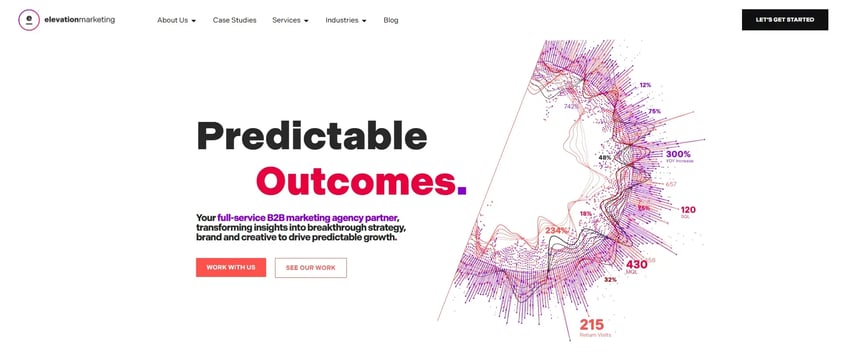
Elevation Marketing is a full‑service B2B marketing agency based in Gilbert, Arizona with additional offices and client reach across the United States and internationally. Founded in 1999, the company focuses on helping B2B brands in industries such as technology, manufacturing, healthcare, financial services, logistics, and professional services grow revenue and shorten sales cycles through integrated marketing programs grounded in data, analytics, and buyer insight. Over more than two decades, Elevation has built strategic relationships with global brands and mid‑market companies, combining research‑based strategy with creative execution to drive measurable outcomes.
Methodology & Services:
Elevation Marketing’s methodology centers on data‑driven B2B strategy and integrated omnichannel execution that aligns marketing and sales around shared revenue goals and buyer engagement. Its service portfolio includes research and insights, brand strategy and positioning, content and creative development, digital performance marketing (SEO, PPC, paid social, programmatic), account‑based marketing (ABM), demand generation, events and trade show support, martech and marketing automation implementation, sales enablement, analytics and attribution measurement, and website design and development. The agency emphasizes research‑backed strategy, advanced analytics, and AI‑enabled insights to inform campaign planning, optimize performance, and demonstrate impact on pipeline and revenue.
Market Position & Brand Perception:
Elevation Marketing positions itself as a strategic growth partner for complex B2B organizations that need coordinated programs across brand, demand generation, sales enablement, and digital experience. Independent profiles highlight its long track record in the B2B sector and recognition on industry lists of top B2B agencies, reflecting its ability to serve diverse sectors with tailored go‑to‑market strategies and measurable performance reporting. Prospective clients typically engage with the agency through a consultation process to define scope and goals that align with business growth objectives.
Pros & Cons
Pros:
-
Deep expertise in B2B integrated marketing strategy and execution that connects brand and demand to measurable pipeline outcomes.
-
Comprehensive service suite including brand strategy, digital performance marketing, ABM, events, sales enablement, and analytics.
-
Long industry history since 1999 with relationships across technology, manufacturing, healthcare, and other B2B sectors.
-
Emphasis on data‑driven insights, martech integration, and analytics to optimize campaigns and show ROI.
Cons:
-
Pricing and engagement details are customized and require consultation rather than being fully transparent online.
-
Broad and sophisticated service offerings may be better suited for mid‑market and enterprise clients rather than very small businesses.
-
Execution of large integrated programs may require internal alignment and coordination from client teams.
The Case for Partnering With a Specialized B2B Agency
Between 2024 and 2026, a significant portion of B2B companies have shifted marketing budgets from in-house teams to agency partnerships. Three converging pressures drive this: media costs on major platforms have increased consistently, talent shortages in specialized areas (demand generation, ABM strategy, AI-driven content) make hiring difficult, and the pace of change in channels and buyer behavior creates upskilling demands that generalist in-house teams struggle to meet.
Long sales cycles of 6-18 months fundamentally change marketing strategy and measurement. In a compressed 3-month B2C cycle, rapid optimization yields results. In a 12-month enterprise software deal, messaging clarity and stakeholder alignment from the first touch compound over many months. B2B marketing agencies have developed proven methodology for this reality, they know how to build strategies that account for extended consideration periods and multi-touch attribution.
B2B agencies help translate technical products into clear value propositions for diverse stakeholders. Consider a 2025 SaaS company launching a data governance platform targeting mid-market enterprises. A typical deal involves an IT director (concerned with deployment complexity), a CISO (focused on compliance), a Chief Data Officer (interested in analytics enablement), and a CFO (evaluating cost and ROI). A specialized agency orchestrates messaging that addresses each decision maker’s priorities without fragmenting into chaos.
Advantages of working with specialized B2B agencies:
- Access to cross-industry benchmarks from managing dozens of SaaS companies simultaneously
- Up-to-date channel expertise across LinkedIn, programmatic, partner marketing, and emerging platforms
- Proven playbooks that compress learning curves and avoid common mistakes
- Ability to shorten sales cycles through coordinated stakeholder engagement
- Predictable pipeline through systematic measurement and optimization
Agencies bring institutional knowledge that’s impossible for an in-house team to accumulate in a reasonable timeframe. When a demand generation agency has seen what messaging resonates across 50 SaaS companies, they bring that deep understanding directly to your engagement.
Developing a Brand Strategy with Your Agency Partner
A robust brand strategy is the foundation for building brand authority and driving measurable results in B2B marketing. When you partner with a marketing agency, developing a brand strategy should be a collaborative process that aligns with your business objectives and speaks directly to your target audience.
The process begins with in-depth research, analyzing market trends, competitor positioning, and customer insights to uncover opportunities for differentiation. Together with your agency partner, you’ll define a unique value proposition and craft a consistent brand voice that resonates across all touchpoints.
A well-executed brand strategy not only elevates your market presence but also positions your company as a thought leader in your industry. By focusing on clarity, consistency, and relevance, your agency can help you build trust with your audience, establish brand authority, and drive growth.
Collaboration is key: your agency should act as an extension of your team, bringing strategic leadership and creative expertise to the table. The result is a brand strategy that supports your business goals, fuels marketing initiatives, and delivers measurable results.
Core Services Offered by B2B Marketing Agencies
Strong B2B agencies offer integrated service offerings that connect brand, demand, and revenue outcomes, not isolated tactics. A truly integrated B2B marketing agency recognizes that brand positioning informs demand generation campaigns, content production supports both SEO and paid media, and analytics data drives quarterly strategy adjustments.
Strategy and Positioning
- Ideal Customer Profile (ICP) research and refinement
- Messaging frameworks addressing different buyer personas
- Go-to-market planning for new products or markets
- Competitive positioning and win/loss analysis
Brand and Creative
- Visual identity and brand strategy development
- Positioning statements and messaging hierarchy
- Customer value proposition mapping
- Brand guidelines ensuring consistency builds trust across campaigns
Content and Thought Leadership
- Long-form pillar content and SEO strategy
- Whitepapers, research reports, and case studies
- Webinars and video content creation
- Sales enablement resources (one-sheets, comparison docs, ROI calculators)
Demand Generation and ABM
- Full-funnel campaigns from awareness to decision
- Account-based marketing for high-value enterprise targets
- Lead generation through gated content and webinar campaigns
- Nurture email sequences aligned to sales cycles
Digital Advertising
- Google Ads and LinkedIn advertising management
- Programmatic display and account-based advertising
- Creative testing and performance marketing optimization
- Channel mix optimization based on pipeline data
Analytics and Revenue Operations
- Marketing automation setup (HubSpot, Marketo)
- CRM integration and data hygiene
- Attribution modeling connecting marketing to revenue
- Dashboard development tracking pipeline and growth metrics
Typical 2026 tools and platforms include LinkedIn Ads and Sales Navigator, Google Ads, programmatic platforms like The Trade Desk, marketing automation systems, customer data platforms for first-party data consolidation, and business intelligence tools for sophisticated attribution.
Not every agency does everything well. The data suggests companies achieve better measurable results by selecting an agency with deep expertise in priority areas rather than one that claims competence across all domains.
How Modern B2B Agencies Build Data-Driven Growth Engines
B2B agencies in 2026 build growth engines on the principle that all marketing data must integrate with CRM systems, enabling end-to-end tracking from first marketing touch to closed-won revenue. The operational foundation involves CRM hygiene, marketing automation tracking lead behavior, analytics integration, and regular data audits ensuring decisions are based on accurate information.
Agencies now explicitly map how early marketing metrics connect to revenue outcomes. Top-of-funnel metrics like impressions and clicks indicate reach. Middle-funnel metrics like MQLs show engagement. Bottom-funnel metrics like SQLs and opportunities indicate genuine buying interest. The critical insight is tracking conversion rates between each stage to identify bottlenecks.
Key metrics agencies track and optimize:
- Cost per lead and cost per SQL
- MQL-to-SQL conversion rates (typically 20-40% for quality programs)
- SQL-to-opportunity conversion (40-70% when sales is effective)
- Pipeline sourced by marketing (dollar amount)
- Customer acquisition cost (CAC) and LTV:CAC ratio
- Sales cycle velocity and win rates
Agencies institutionalize experimentation, running dozens of A/B tests to refine messaging, channels, and targeting. Creative testing rotates different ad variations. Landing page testing compares layouts and copy. Audience testing identifies which firmographics predict highest conversion. A high-functioning agency might run 20-30 experiments per quarter, systematically learning what works for your specific customers.
The role of AI in data-driven growth is accelerating. Predictive lead scoring identifies prospects most likely to convert based on behavioral signals. Content intelligence tools analyze topic clusters and competition to guide content strategy. AI-assisted writing accelerates production while human editors maintain quality. The principle remains: AI tools accelerate execution, but human strategy and creative judgment remain essential.
Key Capabilities to Look For in a B2B Marketing Agency
Selecting an agency in 2026 is less about which services they list on their website and more about capabilities that drive long-term sustainable growth. The specific capabilities you prioritize should align with your business goals and growth stage.
Strategic thinking over tactical execution is the most consequential capability an agency can bring. The best B2B marketing agencies don’t just talk about strategies, they demonstrate their expertise through measurable results and actionable insights. This manifests in quarterly planning workshops where agency and client leadership align on growth objectives, review competitive positioning, and prioritize marketing activities. Agencies with this capability don’t just execute orders, they ask hard questions: “Is our target audience definition still correct?” “Are we messaging value the way our best customers describe it?” Strong agencies bring insights from cross-industry experience to inform your strategy.
Complex buyer journey expertise means understanding and optimizing for multi-stakeholder B2B journeys. Different stakeholders enter consideration at different times, consume different information types, and influence decisions differently. For example, when planning a Q4 enterprise product launch, an agency with this capability maps which content, experiences, or conversations address each persona’s questions at each stage. This requires deep expertise in B2B buying behavior, not just marketing tactics.
Channel-agnostic, data-driven planning approaches channel selection as a strategic decision rather than defaulting to familiar platforms. The agency analyzes where your ICP spends time, which channels drive highest-intent qualified leads, and which channels align with your sales cycle length. For an 18-month enterprise deal, nurture channels matter more than top-of-funnel brand building.
Content excellence is non-negotiable in B2B where consideration cycles are extended and information is the currency of influence. This means thoroughly researched, original content that establishes brand authority, not rehashed commodity content. Strong content creation capabilities span awareness-stage guides, consideration-stage comparisons, and decision-stage implementation resources.
Sales alignment and enablement ensures marketing work actually translates to closed deals. The best agencies build relationships with sales teams through weekly standups reviewing lead flow, monthly analysis of which campaigns source qualified leads, and collaborative development of enablement resources that help sales win.
Industry Leaders: How Top B2B Agencies Drive Results
Industry leaders in B2B marketing, such as 310 Creative, distinguish themselves through deep expertise, innovation, and a relentless focus on measurable outcomes. These agencies don’t just execute campaigns, they develop bespoke strategies tailored to each client’s unique challenges and growth objectives.
Top agencies prioritize collaboration and creativity, working closely with clients to understand their industry landscape and business goals. By leveraging data-driven insights, they continuously optimize their approach, ensuring that every initiative contributes to pipeline growth and real business impact.
What sets industry leaders apart is their commitment to staying ahead of market trends and delivering consistent, tangible results. Their proven methodologies, combined with a culture of innovation and creativity, enable them to drive real growth for their clients, establishing themselves as trusted partners in achieving sustainable success.
Whether it’s through advanced analytics, cutting-edge content strategies, or integrated performance marketing, these agencies deliver the expertise and insights needed to navigate complexity and outperform the competition.
Choosing the Right B2B Marketing Agency for Your Business
The right agency depends on company stage, deal size, industry, and internal team capacity. A seed-stage startup with $500K ARR needs fundamentally different support than a Series C company with $8M ARR.
Selection by company stage:
|
Stage
|
Typical Budget
|
Primary Needs
|
Agency Profile
|
|
Seed to Series B
|
$8K-$20K/month
|
ICP clarity, initial demand gen, prove business model
|
Lean agency or fractional CMO
|
|
Series B-C
|
$20K-$50K/month
|
Scale demand gen, improve efficiency, expand markets
|
Full-funnel partner with execution capability
|
|
Series D+ / Enterprise
|
$30K-$200K/month
|
Specialized ABM, overflow capacity, specific expertise
|
Focused specialists integrated with internal team
|
Evaluation criteria when assessing agencies:
- Industry experience: Request 2-3 case studies from companies with similar scale, sales cycle, and deal complexity
- Proof of revenue impact: Ask for specific metrics, “Increased pipeline from $2M to $5M quarterly” or “Reduced CAC from $8K to $5K”
- Strategic thinking: Evaluate whether they ask thoughtful questions about your business needs or jump to tactics
- Cultural fit: Meet the team who’ll actually execute the work, not just the sales team
- Transparency: Strong agencies are comfortable committing to metrics and reviewing performance openly
- Communication cadence: Understand their reporting rhythm and collaboration approach
Practical evaluation steps:
- Create a 1-2 page brief outlining your goals, target customers, and budget before approaching agencies
- Run a structured RFP with 3-5 agencies, asking each the same questions
- Request references from 2-3 current clients willing to discuss recent results
- Consider a small pilot project ($5K-$10K over 4-6 weeks) before committing to a 12-month retainer
- Don’t just trust your gut feeling, validate claims with data and references
Be cautious of agencies that oversell results without specifics, propose cookie-cutter solutions without learning about your market, or promise guaranteed outcomes without understanding your business.
Customer Experience: The New Battleground in B2B Marketing
Customer experience has emerged as the defining battleground for B2B marketers aiming to achieve real growth and measurable results. In a world where decision makers are inundated with choices, delivering a seamless, personalized experience is essential for building trust and fostering long-term loyalty.
Leading B2B marketers leverage data-driven insights to understand customer needs, anticipate challenges, and tailor every interaction. By focusing on creativity and consistency, they ensure that every touchpoint, from initial engagement to post-sale support, reinforces the brand’s value and reliability.
Prioritizing customer experience means making it a core focus of your marketing strategy. This involves not only optimizing digital journeys but also empowering your team to respond quickly to feedback and adapt to evolving expectations. The result is a stronger connection with your audience, increased loyalty, and a competitive edge that helps your business stay ahead in a rapidly changing market.
By making customer experience central to your marketing efforts, you position your company for sustainable growth, measurable results, and lasting success.
Working With a B2B Marketing Agency: Process and Expectations
A standard B2B agency engagement follows a predictable rhythm. Understanding this timeline helps set realistic expectations and ensures both parties stay aligned throughout the partnership.
Month 1: Onboarding
- Stakeholder interviews with leadership (CEO, VP Sales, VP Product)
- Marketing and analytics audit reviewing CRM, automation platforms, and previous campaigns
- Review of sales collateral, website copy, and recent content
- By month-end, the agency should understand your business sufficiently to develop strategy
Months 2-3: Discovery and Planning
- Refined ICP documentation (company size, industry, tech stack, business challenges)
- Updated messaging framework addressing different buyer personas
- Competitive positioning analysis
- 12-month marketing roadmap with expected outcomes
- Initial execution begins in priority areas
Months 4-12: Optimization and Scaling
- First revenue indicators typically appear at 4-6 months
- Campaign optimization based on accumulated data
- Budget reallocation toward high-performers
- Clear pipeline impact visible by 9-12 months
Collaboration structure for ongoing partnerships:
- Weekly standups (30-60 minutes): Operational alignment on execution
- Monthly strategy reviews (60-90 minutes): Performance analysis and tactical adjustments
- Quarterly business reviews (2+ hours): Strategic planning with senior leadership
Internal alignment is critical. Designate a single owner accountable for the agency relationship, typically the CMO or VP Marketing. This person ensures information flows to the agency, aligns on priorities when conflicts arise, and removes blockers. Without clear internal ownership, agency engagements often stall.
Measuring Success: B2B Metrics That Actually Matter
In 2026, vanity metrics are less useful than revenue-connected KPIs when judging agency performance. Your focus should be on metrics that predict or prove revenue impact, not activity volume.
Core metrics to track:
- MQL to SQL conversion: Typically 20-40% for quality programs; lower suggests targeting issues
- Pipeline sourced by marketing: Dollar amount of opportunities marketing influenced
- Average deal size: Track whether marketing is attracting right-fit customers
- Sales velocity: Time from SQL to closed deal; faster indicates effective nurturing
- Customer acquisition cost (CAC): Total sales and marketing spend divided by customers acquired
- LTV:CAC ratio: 3:1 or higher indicates sustainable growth
Leading vs. lagging indicators matter for real-time optimization. Leading indicators like content engagement, demo requests, and intent signals predict revenue impact 1-3 months forward. Lagging indicators like closed-won revenue and churn confirm past performance but take 6-12 months to accumulate. Track both: leading indicators alert you to problems early, lagging indicators confirm strategy effectiveness.
Example of metric-driven optimization: A Series B SaaS company noticed MQL volume was high but MQL-to-SQL conversion sat at 12%, well below the 20-40% benchmark. Analysis revealed loose targeting was attracting wrong-fit leads. By tightening ICP criteria and refining messaging, they improved MQL-to-SQL conversion to 34% over two quarters while reducing CAC by 28%.
Metrics to prioritize by company stage:
|
Stage
|
Priority Metrics
|
|
Early-stage
|
Lead volume at acceptable quality, messaging resonance
|
|
Growth-stage
|
Cost per SQL, MQL-to-SQL conversion, pipeline sourced
|
|
Enterprise
|
LTV:CAC ratio, expansion revenue, pipeline growth efficiency
|
Common Mistakes Companies Make With B2B Marketing Agencies
Many partnerships fail not because of capability issues but because of misalignment and unclear expectations. Use this section as a pre-engagement checklist to avoid wasting your 2026 budget.
Pitfall 1: No clear internal owner Without a single accountable owner, decisions stall and information doesn’t flow. A 2024 engagement derailed when marketing, sales, and the CEO gave the agency conflicting direction across three months. Fix: Appoint one owner with authority before the engagement starts.
Pitfall 2: Expecting instant results Demand generation requires time to compound. A 60-90 day commitment almost guarantees failure, the agency is still setting up campaigns when the company evaluates results. Fix: Commit to 12 months minimum before assessing success.
Pitfall 3: Underfunding media or execution An agency proposes a $50K/month plan but the company allocates $20K, diluting work across too many initiatives. Nothing gets sufficient investment to drive real growth. Fix: Either increase budget or reduce scope so the plan has actual impact.
Pitfall 4: Siloing the agency from sales If sales doesn’t share feedback on lead quality, the agency keeps generating the same leads without improvement. Fix: Include VP Sales in QBRs and run monthly syncs on lead quality.
Pitfall 5: Changing strategy quarterly A company pivots from “mid-market focus” to “enterprise” mid-year without data, wasting all optimization work. Fix: Commit to annual strategy; adjust only if data explicitly shows current approach isn’t working.
Pitfall 6: Treating agency as order-taker Giving orders without dialogue means the agency can’t apply strategic judgment or bring cross-industry insights. Fix: Involve the agency in planning and treat disagreements as learning opportunities through a collaborative approach.
Future Trends: How B2B Marketing Agencies Are Evolving Beyond 2026
B2B marketing agencies will continue changing as AI, privacy regulations, and new channels mature. Understanding these trends helps you select a partner positioned for innovation rather than one defending static ways of working.
AI integration will become standard operating procedure. Content intelligence platforms will analyze topic clusters and competition before any piece is written. Predictive lead scoring will be ubiquitous for identifying high-probability accounts. AI-assisted writing will accelerate production while human editors maintain quality. The evolution will be toward human-directed AI execution rather than pure automation.
First-party data strategies will replace cookie-dependent approaches. As privacy regulations erode third-party cookies, agencies are building first-party data capabilities, collecting data directly from customers and prospects through website behavior, email engagement, and CRM interactions. Intent data from partners like 6sense and Bombora will become more important for revealing when companies are actively researching solutions.
Revenue operations alignment will accelerate. Rather than marketing being accountable for “pipeline created” and sales for “close rate,” all teams will share accountability for revenue influenced. Agencies will increasingly partner with RevOps teams and help implement unified measurement frameworks.
Regional expansion complexity will increase. As companies mature and look internationally, agencies will face demand for sophisticated expansion support, understanding regulatory environments, local buyer behavior, and competitive landscapes that vary by region.
Future-proof your agency choice by selecting partners with experimentation cultures and strong analytics teams. Agencies comfortable running tests, measuring results, and iterating rapidly will adapt as tools and technology evolve. Those defending static approaches will fall behind industry leaders.
Conclusion: Finding a B2B Agency That Acts Like a True Partner
The best B2B marketing agency in 2026 is not the largest or most expensive, it’s the one that understands your specific buyers, aligns deeply with your business strategy, and is genuinely accountable for revenue outcomes, not just activity completion.
Treating agency selection as a strategic decision on par with hiring a senior marketing leader changes how you approach the process. The right partner functions as an extension of your team, bringing strategic counsel alongside execution and delivering measurable results that matter to your business.
Your agency selection checklist:
- Define specific goals before approaching agencies (pipeline targets, market expansion, CAC improvement)
- Clarify your ICP and buying process to identify which agency capabilities matter most
- Validate track record with evidence, specific metrics, references, and relevant case studies
- Establish shared KPIs and accountability in writing before kickoff
- Commit to a realistic 12-month timeline
Next step: Before speaking with agencies, create a 1-2 page brief outlining your goals for the next 12 months, target customers, current gaps, budget range, and what success looks like. This brief becomes your filter, observe whether agencies ask insightful questions about it or jump straight to pitching their solutions.
The right agency partnership accelerates your path to real growth. The wrong one wastes the budget and time you can’t recover. Choose deliberately.