

SaaS marketing in 2026 looks nothing like it did three years ago. AI-driven buyer journeys mean prospects now engage with personalized content and predictive recommendations long before they ever speak to a human. Tighter budgets, stemming from the 2023–2024 funding winter that saw venture capital deployment drop over 40% year-over-year, have forced SaaS companies to prioritize capital-efficient growth. Meanwhile, B2B sales cycles have stretched to 120–180 days for mid-market deals, making every marketing dollar count more than ever.
In this environment, SaaS marketing agencies that understand subscription economics have become essential partners. Leading agencies ensure their reporting and marketing programs are tied directly to measurable revenue outcomes, such as trials, signups, and ARR growth. Founders and CMOs can no longer accept agencies that report on website traffic or MQL counts without tying those numbers directly to Annual Recurring Revenue growth, Monthly Recurring Revenue acceleration, Customer Acquisition Cost payback periods, and Net Revenue Retention above 110%. The old playbook of vanity metrics, which often correlate with revenue at less than 20% conversion rates, simply doesn’t cut it anymore.
This article is written for founders, CMOs, and go to market leaders at B2B SaaS and product-led growth companies who are sifting through dozens of self-proclaimed specialists. You’ll get a clear definition of what makes a SaaS marketing agency different, an overview of core services, the real benefits of partnering with one, a curated list of notable agencies in 2026, and a practical framework for choosing the right agency for your specific growth stage and business model.
What Is a SaaS Marketing Agency in 2026?
A SaaS marketing agency is a specialized firm that deeply understands subscription revenue models, recurring billing cycles, free trial periods averaging 14–30 days, product-led growth motions where user activation drives adoption without sales intervention, and protracted B2B buying committees involving 6–10 stakeholders.
These SaaS agencies design campaigns specifically around these realities rather than treating SaaS companies like any other business. SaaS marketing agencies often provide specialized SaaS SEO strategies designed to drive product trials, signups, and revenue growth through targeted content, technical SEO, and link building aligned with SaaS buyer journeys.
The contrast with a general digital marketing agency is significant. A generalist might optimize for one-off e-commerce transactions or vanity metrics like click-through rates exceeding 2% on display ads. They rarely think about ARR impact, expansion revenue from upsells, or churn reduction tactics that extend cohort retention. A SaaS agency, on the other hand, structures everything around demo bookings that yield 40–60% show-up rates and trial activations, not generic lead form submissions that boast fill rates above 10% but close at under 5%.
Here’s how the difference plays out in practice:
- A SaaS agency might structure a LinkedIn campaign around ideal customer profile signals like job titles in procurement or IT, with demo CTAs linked to CRM attribution showing 3x higher SQL velocity
- A generalist pushes broad awareness ads measured by impressions, leaving the revenue connection unclear
Strong SaaS agencies work across the full customer lifecycle:
- Acquisition: Multi-channel demand generation achieving CAC under $300 for low-ACV products
- Activation: Optimizing time-to-value within 7 days to boost trial-to-paid conversion to 25%
- Retention: Lifecycle emails reducing churn by 20%
- Expansion: In-app prompts increasing ARPU by 15–30%
- Reactivation: Win-back campaigns recovering 10–15% of lost MRR
Core Services Offered by SaaS Marketing Agencies
Most SaaS marketing agencies in 2026 cluster into three service archetypes: performance-led specialists, content and SEO-led firms, and full funnel GTM partners. Some agencies position themselves as full service partners, offering comprehensive solutions across the entire marketing lifecycle, from strategy and content creation to analytics and execution. Understanding which type you need is often more important than choosing a specific agency name.
Performance-Led Services
Performance-led agencies focus on paid media channels where results can be measured in real time. This includes paid search via Google Ads and Microsoft Ads with AI-driven bidding that adjusts for predicted lifetime value rather than simple cost-per-click. Paid social on LinkedIn targets 2nd-degree connections for 0.5–1.5% CTR and demo bookings at $50–150 each. Meta handles top-of-funnel awareness, while display and programmatic retargeting maintains 70% viewability standards.
Conversion rate optimization is central to performance marketing for SaaS businesses. This means A/B tests on pricing pages that lift conversions by 20–50%, all integrated with CRM systems like Salesforce or HubSpot so attribution flows from click to closed-won revenue.
Content and SEO-Led Services
Content marketing and seo content marketing agencies build organic growth engines for SaaS brands. Content marketing SEO is a key component of integrated SaaS marketing strategies, supporting inbound marketing and qualified lead generation. Marketing SEO is central to multi-channel demand generation frameworks for SaaS companies, playing a crucial role in driving high-quality demand and supporting account-based marketing approaches. Their work revolves around ICP-derived search strategies using jobs-to-be-done frameworks, targeting queries like “best CRM for remote teams” with long-form, driven content: strategic, data-driven, and insight-driven blogs of 3,000+ words that drive 5–10% organic conversion to trials and help establish authority and improve rankings.
Key services include:
- Comparison pages that outperform competitors by 30% in rankings
- Downloadable templates gating 20–40 leads per asset
- Link building campaigns securing 50–100 DA40+ backlinks quarterly for topical authority
- Technical seo audits ensuring proper crawlability and site speed
The goal is converting organic traffic at 3–8% to product signups, a sustainable growth strategy that compounds over time.
Full-Funnel GTM Services
Full-funnel and GTM partners take a broader view. They help with ICP definition, narrowing your total addressable market from billions to $100M+ serviceable segments. Messaging architecture gets tested via customer interviews until you achieve 80% message-market fit. Positioning frameworks, including category creation for undifferentiated products, become the foundation for all marketing execution.
These agencies also handle sales enablement with battlecards and objection handlers that shorten cycles by 20%, revenue operations automating workflows, lifecycle email sequences with 40% open rates, and onboarding flows reducing time-to-activation by 50%.
Supporting Specialties
Many SaaS agencies also offer marketing automation setups on HubSpot or Marketo handling 10,000+ contacts, analytics platforms like Google Analytics 4 or Mixpanel for funnel analysis, multi-touch attribution models assigning 30–40% credit to first-touch, and creative production for product tours that garner 2–5x engagement over static assets.
Benefits of Partnering With a SaaS Marketing Agency
Post-seed and Series A companies, often capped at 5–10 person teams, face a stark choice: spend 6–9 months hiring specialists in a tight talent market where 25% of marketing roles went unfilled in 2025, or partner with an agency that brings immediate capability.
Here are the concrete benefits of choosing the agency path:
- Immediate access to proven playbooks: Agencies bring benchmarks from 500+ SaaS clients, trial-to-paid conversions of 20% for $50–100 ACV bands, 15% for $1K+ ACV, payback targets under 18 months aligning with 1.5–3x LTV:CAC ratios. You don’t have to learn these the hard way.
- Execution speed that internal teams can’t match: Agencies can launch multi-channel campaigns in 2–4 weeks versus months for internal ramp-up. They iterate via weekly tests, scaling winners 3–5x while killing losers early to maintain 20–30% month-over-month efficiency gains.
- Strategic clarity from outside perspective: Strong agencies challenge flawed positioning, for example, shifting from feature-led to outcome-led messaging that boosts demo rates by 40%. They conduct win/loss analysis revealing the 70% misalignment that often exists in early ICP drafts.
- Risk reduction through flexible cost structure: Fixed retainers of $10K–50K per month can replace 3–5 FTEs at $150K+ salaries plus tools like SEMrush ($300/month) and training costs. Performance-based fees tying 20–30% to pipeline milestones align incentives.
- Access to enterprise-grade tools and talent: Agencies spread tool costs across multiple clients, giving you access to capabilities that would be prohibitively expensive for a single company.
- Faster learning curves on new channels: When a new platform or tactic emerges, agencies test it across their client base and bring validated approaches to your business.
Overall, agencies can deliver 2–4x ROI on spend within 6 months according to client testimonials. The key limitation is dependency risk, if you don’t vet for depth, you may find yourself reliant on agency playbooks that don’t fit your unique market.
Types of SaaS Marketing Agencies in 2026
Not all SaaS agencies do the same thing. Before choosing a specific partner, founders should first identify which type of agency matches their primary constraint.
Performance-Led SaaS Growth Agencies excel in paid acquisition for B2B SaaS companies with ACVs from around $5,000 to $250,000. They generate demos at $75–200 CAC through structured experimentation frameworks, testing 10+ creatives weekly and tying attribution to pipeline value exceeding $1M quarterly. These agencies are best for SaaS companies that want to scale a proven funnel with capital efficiency. If you know your ICP and your offer converts, performance marketing specialists can pour fuel on the fire.
Content and SEO-Led SaaS Agencies construct organic growth engines for categories with established search demand. They typically invest $20K–50K per month in content strategy that yields 50K+ monthly organics converting at 5% after a 6–12 month ramp period. These firms suit SaaS businesses where buying cycles can be influenced via education, comparison content, and thought leadership. If you’re playing a long term game and want inbound marketing that compounds, this is your category.
Full-Funnel GTM and Fractional CMO Partners orchestrate for early-to-growth stage SaaS teams. They embed senior leaders to define ICPs (reducing waste by 30%), build positioning via 20+ customer interviews, and align channels for 2x pipeline velocity. These partners work best for enterprise SaaS companies or stage SaaS startups that lack strategic marketing leadership and need help figuring out what to build before scaling execution.
Niche SaaS Specialists have emerged for specific use cases: PLG optimization agencies auditing funnels for 25% lift in activation, lifecycle specialists cutting churn 15% via predictive modeling, and LinkedIn thought leadership agencies amplifying founder brands to 10x impression share. These make sense when you’ve diagnosed a specific bottleneck that requires deep expertise.
The type you choose depends on your growth stage, primary constraint, and whether you need channel depth or strategic orchestration.
Top SaaS Marketing Agencies to Know in 2026
This is not a ranking but a curated snapshot of well-known SaaS marketing agencies across different specialties ranging from multichannel marketing to demand generation. Each profile highlights focus, typical client profile, and core strengths so you can map options to your own needs.
#1. 310 Creative
Company Overview:
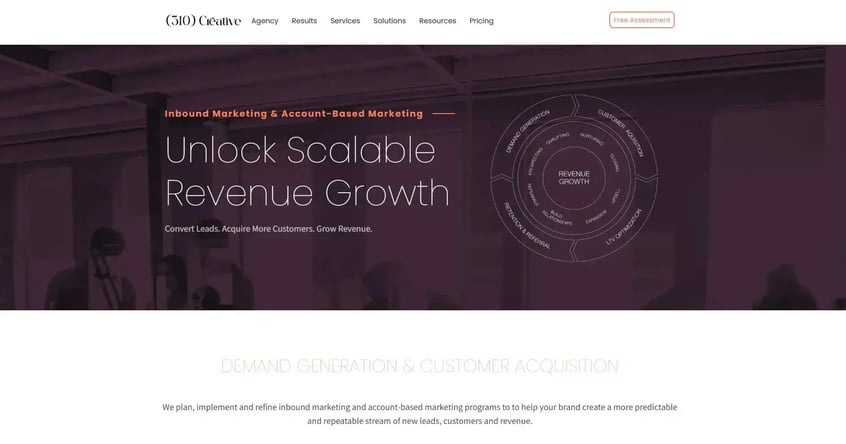
310 Creative is a B2B SaaS marketing agency founded in 2003 and headquartered in Santa Monica, California. The agency specializes in helping SaaS and technology companies generate predictable pipeline, accelerate revenue growth, and improve customer acquisition through inbound marketing and demand generation programs. As a Platinum HubSpot Partner, 310 Creative focuses heavily on building scalable marketing and sales systems inside HubSpot that align marketing automation, CRM data, and revenue reporting. The firm works with venture-backed startups, mid-market SaaS companies, and established technology brands seeking structured growth and measurable ROI.
Methodology & Services:
310 Creative’s methodology centers on full-funnel SaaS demand generation and revenue operations alignment. The agency builds inbound engines designed to attract qualified buyers, convert them into leads, nurture them through automated workflows, and support sales teams with structured enablement assets. Core SaaS services include inbound strategy, account-based marketing, SEO and content marketing, paid media management, conversion rate optimization, marketing automation architecture, HubSpot CRM implementation and optimization, lead scoring, lifecycle marketing, and sales enablement development. Website design and growth-driven design are also central to its approach, ensuring SaaS companies have conversion-optimized digital experiences that support pipeline growth.
Market Position & Brand Perception:
310 Creative positions itself as a strategic SaaS growth partner rather than a generalist agency, with deep expertise in HubSpot-centric revenue infrastructure and inbound marketing systems. Its Platinum HubSpot Partner status reinforces credibility in marketing automation, CRM integration, and lifecycle marketing for SaaS organizations. The agency emphasizes transparency, reporting clarity, and measurable outcomes tied to pipeline and revenue rather than traffic alone. Engagements are typically structured around retainer-based partnerships with clearly defined growth objectives and performance metrics aligned to SaaS KPIs such as MQL to SQL conversion, customer acquisition cost, and recurring revenue growth.
Pros & Cons
Pros:
-
Strong specialization in SaaS demand generation and revenue operations
-
Full-funnel expertise with advanced CRM and marketing automation expertise
-
Full-funnel services including ABM, SEO, paid media, lifecycle marketing and sales enablement
-
Emphasis on measurable SaaS KPIs such as pipeline growth, CAC, and recurring revenue
- Offers month-to-month engagements to ensure you are running profitable campaigns
Cons:
-
Pricing starts at $4,000 - $15,000 per month, ideal for more mature SaaS companies
-
Retainer-based model may require mid-market or venture-backed budget levels
-
Primarily inbound marketing and account-based marketing focused, which may not suit product-led growth models that rely less on traditional demand generation
#2. Kalungi
Company Overview:
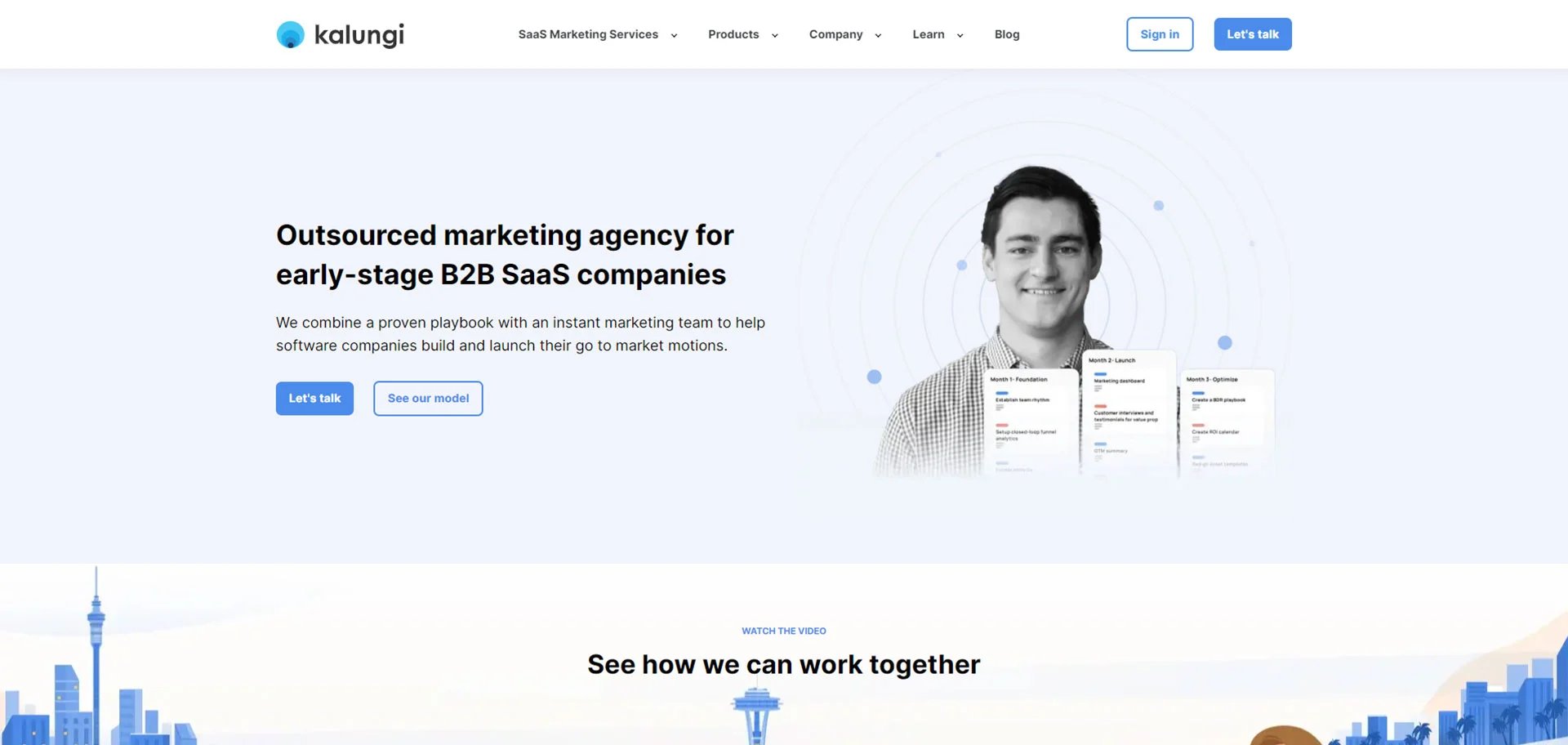
Kalungi is a B2B SaaS marketing agency and fractional CMO firm focused exclusively on helping early-stage and growth-stage software companies build scalable marketing engines. Founded in 2018 and headquartered in Seattle, Washington, Kalungi positions itself as a full-service outsourced marketing team for SaaS startups that need executive-level strategy and hands-on execution without hiring a complete in-house department. The firm works primarily with seed to Series B SaaS companies, helping them establish go-to-market strategy, define positioning, and build predictable pipeline generation systems aligned to recurring revenue growth.
Methodology & Services:
Kalungi’s methodology centers on its T2D3 growth framework, which is designed to help SaaS companies triple revenue twice and then double revenue three times through disciplined go-to-market execution. The agency provides fractional CMO leadership, demand generation strategy, content and SEO, paid acquisition, account-based marketing, marketing automation, HubSpot implementation, website development, product marketing, positioning and messaging, and sales enablement. Kalungi integrates strategy, channel execution, analytics, and revenue operations to build a repeatable marketing foundation tailored to SaaS metrics such as ARR growth, CAC efficiency, pipeline velocity, and customer lifetime value.
Market Position & Brand Perception:
Kalungi positions itself as a specialized SaaS growth partner rather than a general digital marketing agency. Its exclusive focus on SaaS, combined with a structured playbook and embedded fractional leadership model, differentiates it from traditional agencies that provide only tactical execution. The firm emphasizes long-term partnership, recurring revenue optimization, and building internal marketing capability over time. Engagements are typically structured around monthly retainers that bundle executive strategy with execution resources, making Kalungi particularly attractive to venture-backed startups that need both strategic direction and operational capacity.
Pros & Cons
Pros:
-
Exclusive focus on B2B SaaS startups and growth-stage software companies
-
Fractional CMO leadership combined with full marketing team execution
-
Structured T2D3 growth framework aligned to ARR and SaaS revenue metrics
-
Strong emphasis on building repeatable, scalable marketing systems
Cons:
-
Primarily suited for early-stage and growth-stage SaaS rather than enterprise organizations
-
6-12 month retainer-based engagement model may require committed marketing investment
-
Heavy emphasis on structured frameworks may require organizational discipline and alignment to execute effectively
#3. SimpleTiger
Company Overview:
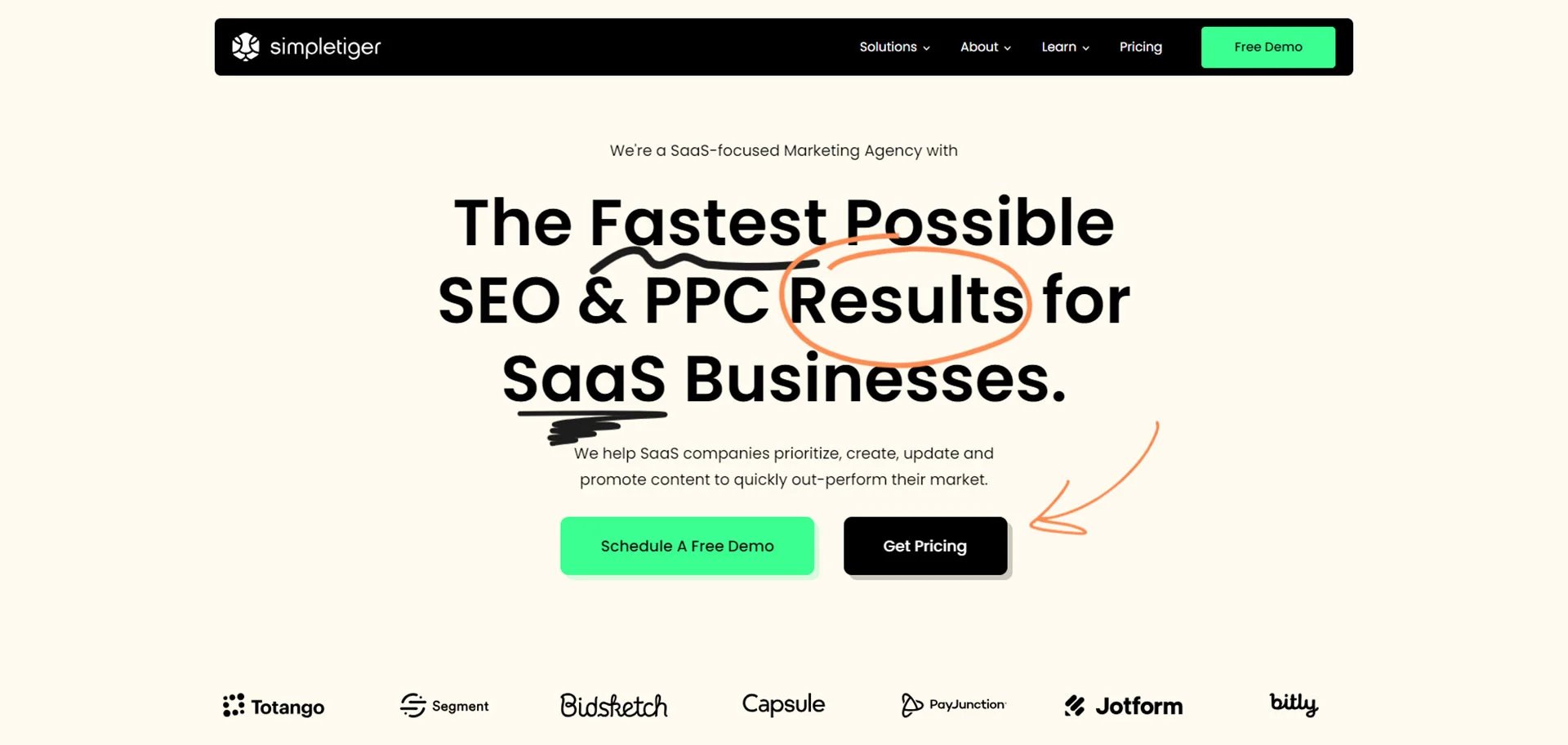
SimpleTiger is a SaaS marketing agency founded in 2006 and headquartered in Sarasota, Florida. The agency focuses exclusively on helping software companies grow recurring revenue through search-driven demand generation, paid acquisition, and content marketing. SimpleTiger works with bootstrapped startups, venture-backed SaaS companies, and established software brands, positioning itself as a specialized partner that understands subscription economics, customer acquisition cost management, and scalable pipeline growth. Its long-standing focus on SaaS differentiates it from generalist digital marketing agencies.
Methodology & Services:
SimpleTiger’s methodology centers on data-driven SaaS demand generation with a strong emphasis on SEO and paid search performance. Core services include technical SEO, content strategy and long-form content production, paid search management, conversion rate optimization, landing page design, and marketing analytics. The agency prioritizes keyword strategy aligned to high-intent SaaS buyer queries and integrates SEO insights into broader growth initiatives. Campaign reporting is structured around SaaS-specific metrics such as monthly recurring revenue growth, customer acquisition cost efficiency, lifetime value optimization, and pipeline contribution rather than traffic alone.
Market Position & Brand Perception:
SimpleTiger positions itself as a specialist SaaS growth partner with deep expertise in organic and paid acquisition channels rather than a full-service brand agency. The firm emphasizes measurable ROI, transparent reporting, and long-term partnerships built around predictable growth models. Its exclusive focus on SaaS allows it to develop industry-specific knowledge across subscription pricing models, trial conversions, freemium funnels, and product-led growth strategies. Engagements are typically retainer-based and designed for companies that want a focused, performance-oriented marketing engine built around search and acquisition channels.
Pros & Cons
Pros:
-
Exclusive focus on SaaS marketing and subscription-based growth models
-
Strong expertise in SEO, paid search, and performance-driven demand generation
-
Reporting aligned to SaaS KPIs such as MRR, CAC, and lifetime value
-
Long operational history with nearly two decades of SaaS marketing experience
Cons:
-
Primary emphasis on search and acquisition channels rather than full brand or creative strategy
-
Retainer model may require sustained budget commitment
-
May not be ideal for SaaS companies seeking broad omnichannel marketing beyond search and paid acquisition
#4. New North
Company Overview:
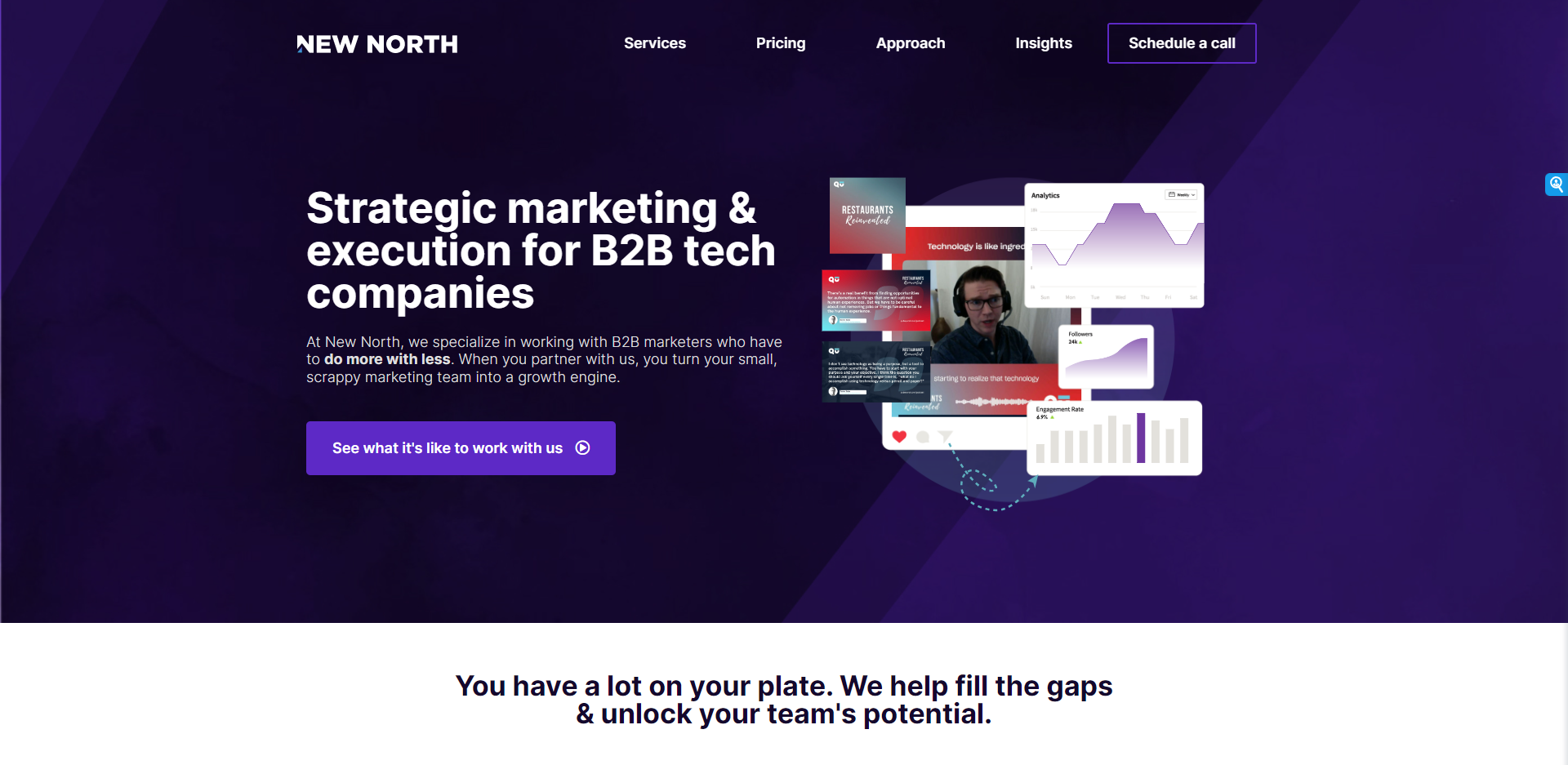
New North is a B2B marketing agency focused on technology and SaaS companies that helps small to mid-sized software firms generate qualified leads, strengthen positioning, and scale revenue through structured digital marketing programs. Founded in 2008 and headquartered in Frederick, Maryland, the agency operates as an extension of internal marketing teams, providing both strategic planning and hands-on execution. New North emphasizes transparency, measurable results, and close collaboration, making it particularly well suited for SaaS organizations that need consistent demand generation but lack a fully built in-house marketing department.
Methodology & Services:
New North’s methodology centers on data-driven SaaS demand generation aligned to revenue growth objectives. The agency develops tailored go-to-market programs that integrate account-based marketing, content marketing, SEO, paid media, email marketing, and marketing automation. For SaaS clients, services often include messaging refinement, buyer persona development, website optimization, lifecycle marketing, and CRM reporting integration to improve conversion rates and shorten sales cycles. Campaign performance is measured against pipeline contribution, SQL generation, and revenue impact rather than surface metrics such as traffic alone.
Market Position & Brand Perception:
New North positions itself as a strategic growth partner for emerging and mid-market SaaS companies that require a practical and execution-focused marketing team. The agency differentiates itself through transparent project management systems, collaborative workflows, and reporting visibility that gives SaaS leadership teams clear insight into performance and ROI. Engagements are typically structured as retainer-based partnerships with flexible scopes designed to support ongoing optimization and iterative growth rather than one-time campaign execution.
Pros & Cons
Pros:
-
Strong focus on B2B technology and SaaS demand generation
-
Integrated services including ABM, content, SEO, paid media, and marketing automation
-
Transparent reporting and collaborative execution model
-
Well suited for SaaS companies building structured pipeline programs
Cons:
-
Primarily oriented toward small to mid-market SaaS rather than large enterprise software firms
-
Retainer-based engagement model requires ongoing budget commitment
-
Broader full-service positioning may not offer the deep specialization of agencies focused exclusively on one acquisition channel
#5. Bay Leaf Digital
Company Overview:
Bay Leaf Digital is a B2B SaaS marketing agency founded in 2013 and headquartered in North Texas. The agency focuses exclusively on helping SaaS companies grow recurring revenue through strategic demand generation and digital marketing programs aligned to subscription economics. Bay Leaf Digital works primarily with venture-backed and growth-stage SaaS organizations that need to scale pipeline, optimize customer acquisition cost, and accelerate annual recurring revenue. Its positioning emphasizes measurable performance, executive-level visibility into marketing impact, and alignment between marketing investment and revenue outcomes.
Methodology & Services:
Bay Leaf Digital’s methodology centers on data-driven SaaS demand generation tied directly to pipeline and ARR growth. The agency builds integrated programs that combine paid media, SEO, content marketing, marketing automation, conversion rate optimization, analytics, and reporting. For SaaS clients, services often include buyer persona development, messaging and positioning refinement, lifecycle marketing, funnel optimization, and CRM attribution modeling to track marketing’s contribution to sales. Performance measurement is aligned to SaaS metrics such as MQL to SQL conversion, CAC efficiency, pipeline velocity, and revenue attribution rather than surface engagement metrics.
Market Position & Brand Perception:
Bay Leaf Digital positions itself as a specialized SaaS growth partner rather than a general digital marketing agency. Its exclusive focus on B2B SaaS allows it to tailor strategy around subscription models, long sales cycles, and complex buying committees. The agency emphasizes accountability, transparency, and executive reporting that connects marketing activities to revenue performance. Engagements are typically retainer-based and structured to support continuous optimization, making Bay Leaf Digital particularly attractive to SaaS leadership teams seeking predictable and scalable growth systems.
Pros & Cons
Pros:
-
Exclusive focus on B2B SaaS marketing and subscription-based growth models
-
Strong alignment to pipeline, ARR, CAC, and revenue attribution metrics
-
Integrated demand generation services across paid, organic, content, and automation
-
Emphasis on executive reporting and measurable marketing ROI
Cons:
-
Primarily suited for SaaS companies rather than broader B2B or B2C industries
-
Retainer-based engagement model requires consistent marketing investment
-
May be less focused on brand-heavy creative initiatives compared to traditional creative agencies
#6. Straight North
Company Overview:
Straight North is a full-service digital marketing agency founded in 1997 and headquartered in Downers Grove, Illinois, with additional offices across the United States. While the agency serves both B2B and B2C clients, it works with SaaS and technology companies seeking to increase qualified leads, demo requests, and subscription revenue through performance-driven digital marketing. Straight North emphasizes measurable outcomes and transparent reporting, positioning itself as a growth partner that connects marketing activity directly to validated leads and revenue impact. Its long operational history and experienced in-house team support SaaS companies looking for structured acquisition programs.
Methodology & Services:
Straight North’s methodology centers on data-driven demand generation and conversion optimization. For SaaS companies, services typically include search engine optimization, pay per click advertising, paid social campaigns, content marketing, web design and development, email marketing, and conversion rate optimization. The agency leverages its proprietary GoNorth Reporting platform to track calls, form submissions, and lead sources, enabling SaaS leadership teams to understand which channels are contributing to pipeline growth. Campaign strategies are aligned to performance metrics such as cost per lead, demo conversions, sales qualified leads, and revenue attribution rather than traffic alone.
Market Position & Brand Perception:
Straight North positions itself as a performance-focused digital marketing partner rather than a niche SaaS-only firm. Its value for SaaS companies lies in its structured lead validation processes, transparent analytics, and multi-channel expertise across organic and paid acquisition. The agency is particularly suited for SaaS organizations seeking to strengthen inbound lead generation and optimize digital acquisition funnels. Engagements are generally customized and retainer-based, with strategies tailored to the growth stage and revenue goals of each client.
Pros & Cons
Pros:
-
Strong emphasis on validated lead tracking and measurable revenue impact
-
Comprehensive digital acquisition services including SEO, PPC, paid social, and web development
-
Proprietary reporting platform that provides channel-level attribution visibility
-
Long operational history and experienced in-house U.S.-based team
Cons:
-
Not exclusively focused on SaaS, which may limit deep specialization in subscription-specific growth models
-
Broad service offering may not provide the strategic SaaS positioning depth of SaaS-only agencies
-
Retainer-based programs may require consistent marketing investment and internal coordination
#7. Omniscient Digital
Company Overview:
Omniscient Digital is a B2B SaaS organic growth agency founded in 2019 and headquartered in Austin, Texas. The agency works exclusively with software and technology companies to build scalable organic acquisition engines that drive qualified pipeline and recurring revenue. Omniscient positions itself as a strategic partner for SaaS brands that want to turn SEO and content into durable, compounding growth channels rather than short-term traffic initiatives. Its leadership team includes experienced SaaS operators and growth marketers who have led content and SEO at high-growth technology companies.
Methodology & Services:
Omniscient’s methodology centers on high-impact SEO and content programs aligned to SaaS revenue metrics. Engagements begin with deep research into product positioning, competitive landscape, search intent, and buyer journey mapping to identify opportunities that influence pipeline, not just impressions. Core services include SEO strategy, technical SEO, long-form content production, thought leadership content, digital PR and link acquisition, generative search optimization, and analytics reporting tied to conversions and revenue attribution. For SaaS companies, campaigns are structured around high-intent keywords, product-led content, and content assets that support demos, trials, and sales conversations.
Market Position & Brand Perception:
Omniscient positions itself as a specialized SaaS SEO and content growth partner rather than a full-service digital agency. Its exclusive focus on B2B SaaS allows it to tailor strategy around subscription economics, long sales cycles, and product-led growth models. The agency emphasizes quality, authority building, and measurable performance outcomes such as qualified leads, sales accepted opportunities, and pipeline contribution. Engagements are typically retainer-based and structured for long-term organic growth, making Omniscient particularly suited for SaaS companies seeking sustainable acquisition rather than short-term paid traffic spikes.
Pros & Cons
Pros:
-
Exclusive focus on B2B SaaS organic growth and SEO-driven demand generation
-
Deep expertise in technical SEO, content strategy, and high-intent keyword targeting
-
Emphasis on pipeline impact and revenue attribution rather than vanity traffic metrics
-
Strong alignment with product-led growth and subscription-based business models
Cons:
-
Primarily focused on organic channels rather than paid media or full omnichannel marketing
-
Retainer-based model requires long-term commitment to realize compounding SEO results
-
May not be ideal for SaaS companies seeking rapid short-term growth through aggressive paid acquisition
#8. NoGood
Company Overview:
NoGood is a growth marketing agency founded in 2017 with offices in New York City and Los Angeles that works extensively with SaaS, technology, and direct-to-consumer brands. The agency positions itself as a data-driven growth partner that blends experimentation, performance marketing, and creative execution to accelerate customer acquisition and revenue. For SaaS companies, NoGood focuses on scalable growth systems that support recurring revenue models, product-led growth initiatives, and venture-backed expansion strategies.
Methodology & Services:
NoGood’s methodology centers on rapid experimentation and full-funnel growth optimization designed to identify and scale the highest-performing acquisition channels. For SaaS clients, core services include paid search and paid social advertising, performance creative, SEO and content marketing, conversion rate optimization, lifecycle and email marketing, analytics and attribution modeling, and marketing automation. The agency emphasizes structured testing frameworks, cross-channel performance tracking, and continuous optimization aligned to SaaS metrics such as customer acquisition cost, activation rate, retention, lifetime value, and pipeline growth. Campaigns are designed to integrate acquisition, activation, and retention rather than focusing solely on top-of-funnel traffic.
Market Position & Brand Perception:
NoGood positions itself as a growth-first partner for SaaS and technology brands seeking aggressive, experiment-driven scaling rather than traditional brand marketing. Its client portfolio includes venture-backed startups and enterprise technology companies, reinforcing its credibility in high-growth environments. The agency is particularly well suited for SaaS organizations pursuing product-led growth, rapid user acquisition, and data-centric marketing infrastructure. Engagements are typically retainer-based and structured around cross-functional teams dedicated to performance outcomes and measurable revenue impact.
Pros & Cons
Pros:
-
Strong focus on growth experimentation and SaaS performance metrics
-
Integrated acquisition and retention services including paid media, SEO, CRO, and lifecycle marketing
-
Data-driven testing frameworks aligned to CAC, LTV, activation, and revenue growth
-
Experience working with high-growth and venture-backed SaaS companies
Cons:
-
Heavy emphasis on performance marketing may not prioritize long-term brand development
-
Retainer and growth team model may require significant ongoing marketing investment
-
Fast-paced experimentation approach may require internal alignment and tolerance for rapid iteration
#9. Roketto
Company Overview:
Roketto is a B2B SaaS inbound marketing agency founded in 2010 and headquartered in Kelowna, British Columbia. The agency focuses on helping SaaS and technology companies generate qualified leads, accelerate pipeline growth, and improve recurring revenue through inbound marketing and marketing automation. Roketto positions itself as a strategic growth partner that combines creative execution with structured revenue operations to build scalable acquisition systems for subscription-based businesses.
Methodology & Services:
Roketto’s methodology centers on inbound-driven SaaS demand generation aligned to revenue metrics. The agency develops integrated programs that include SEO, content marketing, paid media, conversion rate optimization, marketing automation, HubSpot implementation, website design and development, sales enablement, and CRM reporting integration. For SaaS companies, Roketto emphasizes funnel alignment from awareness to closed revenue, building automated nurturing workflows and conversion-optimized digital experiences designed to improve demo bookings, trial activations, and sales qualified leads. Performance is measured against SaaS KPIs such as MQL to SQL conversion, pipeline contribution, and customer acquisition cost efficiency.
Market Position & Brand Perception:
Roketto positions itself as a specialized SaaS inbound growth partner rather than a general digital marketing agency. Its focus on HubSpot, automation, and sales alignment makes it particularly suitable for SaaS organizations seeking to formalize revenue operations and create predictable lead generation systems. The agency emphasizes transparency, collaboration, and long-term partnership models, with engagements typically structured as retainer-based programs designed for sustained growth rather than short-term campaign execution.
Pros & Cons
Pros:
-
Strong focus on SaaS inbound marketing and revenue operations alignment
-
Integrated services including SEO, content, paid media, automation, and sales enablement
-
HubSpot expertise supporting lifecycle marketing and CRM integration
-
Emphasis on measurable pipeline and recurring revenue growth
Cons:
-
Primarily inbound-focused, which may not suit SaaS companies prioritizing aggressive paid acquisition or product-led growth experimentation
-
Retainer-based model requires ongoing marketing investment
-
Heavier emphasis on HubSpot ecosystem may limit flexibility for alternative tech stacks
#10. Animalz
Company Overview:
Animalz is a content marketing agency focused on B2B SaaS and technology companies that helps brands drive growth through high-quality, research-driven content programs. Founded in 2015 and operating as a distributed team, Animalz works with venture-backed startups and established software companies to build authoritative content engines that support demand generation and product positioning. The agency positions itself as a strategic partner that prioritizes depth, credibility, and long-term brand equity over high-volume content production.
Methodology & Services:
Animalz’s methodology centers on strategic SaaS content marketing aligned to revenue and product growth objectives. Engagements typically begin with in-depth research into audience needs, product differentiation, and competitive positioning to shape a long-term editorial roadmap. Core services include blog and long-form content creation, thought leadership development, white papers, customer stories, product marketing content, SEO-informed strategy, and content optimization. Rather than focusing solely on keyword traffic, Animalz emphasizes content that supports sales conversations, educates technical buyers, and builds authority in competitive SaaS categories.
Market Position & Brand Perception:
Animalz positions itself as a premium SaaS content partner rather than a full-service digital marketing agency. Its client portfolio includes high-growth and enterprise technology companies, reinforcing its reputation for quality and strategic depth. The agency is particularly well suited for SaaS organizations that prioritize brand authority, thought leadership, and long-term organic growth. Engagements are typically retainer-based and focused on sustained content investment designed to compound over time and support pipeline development.
Pros & Cons
Pros:
-
Exclusive focus on B2B SaaS and technology content marketing
-
Emphasis on high-quality, research-driven thought leadership content
-
Aligns content strategy to pipeline influence and product positioning
-
Strong reputation among venture-backed and enterprise SaaS brands
Cons:
-
Primarily focused on content rather than full omnichannel marketing services
-
Premium positioning may require significant content investment
-
Less emphasis on paid acquisition or rapid experimentation compared to growth agencies

Agency Expertise: Content Creation, Inbound Marketing, and Enterprise Solutions
A top-tier SaaS marketing agency brings together deep expertise in content creation, inbound marketing, and enterprise solutions, three pillars essential for driving sustainable growth in today’s competitive SaaS landscape. High-quality content creation is at the heart of effective SaaS marketing, enabling companies to educate their audience, establish thought leadership, and generate steady streams of organic traffic. Whether it’s long-form blog posts, in-depth guides, or data-driven whitepapers, compelling content positions SaaS companies as trusted authorities and fuels every stage of the buyer’s journey.
Inbound marketing strategies, spanning SEO, PPC, and social media, are equally critical. By leveraging targeted SEO and PPC campaigns, agencies help B2B SaaS companies attract high-intent prospects actively searching for solutions. Social media amplifies reach and engagement, nurturing leads and building brand affinity over time. These inbound tactics are designed to pull prospects in, rather than push messages out, resulting in more qualified leads and higher conversion rates.
For SaaS businesses aiming to scale, enterprise solutions like marketing automation and customer retention programs are game-changers. Marketing automation streamlines lead nurturing, scoring, and segmentation, ensuring that every touchpoint is personalized and timely. Customer retention initiatives, such as lifecycle email campaigns and loyalty programs, help maximize customer lifetime value and reduce churn, supporting long-term growth.
By combining these areas of expertise, SaaS marketing agencies deliver tailored strategies that address the unique challenges of B2B SaaS companies. The result is a holistic approach to marketing that drives organic growth, supports customer acquisition and retention, and positions SaaS brands for long-term success in a crowded market.
How to Choose the Right SaaS Marketing Agency for Your Business
Choosing the right SaaS marketing agency depends heavily on growth stage (pre-product-market fit versus scale-up), ACV band, sales motion (sales-led versus PLG), and internal capabilities. A $2M ARR company with a sales-led motion needs different help than a $10M ARR PLG company with strong product analytics.
Use this 4-step framework to narrow your search:
Step 1: Diagnose Your Main Constraint
Before you talk to any agency, identify what’s actually holding back your growth:
- Lack of qualified traffic → Consider performance specialists or SaaS SEO agencies
- Low trial-to-paid conversion → Look at CRO and PLG optimization specialists
- Unclear positioning or ICP → Engage full-funnel GTM partners
- High churn or low expansion → Find lifecycle and customer retention specialists
Most SaaS teams have multiple issues, but there’s usually one constraint that, if solved, would unlock the others.
Step 2: Decide Channel Depth vs. Full-Funnel
If 80% of your revenue comes from one channel, you may need a deep specialist who can optimize that channel to its limits. If you’re still figuring out which channels work, a full-funnel partner who can orchestrate experimentation makes more sense.
Be wary of “we do everything” agencies that lack depth in any single area.
Step 3: Define Success Metrics for the First 6 Months
Get specific about what success looks like:
- X more demos per month
- Y% increase in SQLs
- Z% reduction in CAC
- Improved payback period from 18 months to 12 months
- NRR improvement from 100% to 110%
Agencies should be willing to commit to these metrics in some form.
Step 4: Shortlist 3–5 Agencies and Evaluate
Review at least 2–3 detailed case studies where the agency improved concrete SaaS specific metrics, MRR growth rate, churn reduction, CAC payback, or recurring revenue expansion. Generic testimonials about “great partnership” aren’t enough.
Run a structured discovery process: share your current funnel metrics from the last 6–12 months, ask for their diagnosis and proposed priorities, and assess how clearly they think. The best SaaS agencies ask hard questions rather than immediately pitching solutions.
Key Evaluation Criteria for SaaS Marketing Agencies
When speaking with agencies in 2026, use this checklist to go beyond portfolios and awards.
Commercial Understanding of SaaS Metrics
- Does the agency talk credibly about NRR (target >110%), GRR (>90%), CAC:LTV ratio (>1:3), ARPA growth (10–20% YoY)?
- Can they distinguish between logo churn (5%) and revenue churn (3%)?
- Do they understand PLG funnels (signups, PQLs from product signals) and sales-led funnels (MQL-to-SQL at 30–50% conversion)?
Growth Stage Fit
- Early-stage (0–$1M ARR): You need experimentation and fast feedback, 10+ tests per month
- Growth-stage ($1M–$20M ARR): You need scalable systems and multi-channel orchestration handling >$100K in ad spend
- Late-stage / enterprise: You need ABM aligning 10+ stakeholders, complex global programs
Channel Depth vs. Full-Funnel Capability
- Probe whether 50%+ of their client revenue comes from one channel (indicating depth) or if they spread thin across everything
- Spot “we do everything” generalists who lack real expertise in any single area
- Match your constraint to their strength
Revenue Alignment and Accountability
- Look for agencies that agree to be measured on qualified pipeline and revenue contribution, not just clicks and impressions
- They should work inside your CRM (Salesforce, HubSpot, Pipedrive) for proper attribution
- Multi-touch attribution models should assign clear credit across touchpoints
Operating Model and Communication
- Weekly standups with clear agendas
- Monthly dashboards with pipeline metrics
- Quarterly business reviews (QBRs) assessing strategy
- Clear project management in tools like Asana or Slack
- Named strategic owners, not rotating junior staff on your account
Cultural and Process Fit
- Reference calls probing NRR impact and actual working relationship
- Pricing transparency: expect $15K–75K retainers plus 10–20% of ad spend
- Clear onboarding process and ramp timeline expectations
Measuring Success with a SaaS Marketing Agency
To ensure your investment in a SaaS marketing agency delivers real business impact, it’s essential to measure success using clear, data-driven metrics. The right SaaS marketing agency will align their efforts with your company’s growth objectives, focusing on KPIs that matter most for SaaS businesses, such as customer acquisition cost (CAC), customer lifetime value (LTV), conversion rates, and organic traffic growth.
A data-driven approach to marketing means tracking every campaign’s performance, from initial lead generation to closed-won deals. By monitoring CAC, you can assess how efficiently your agency is acquiring new customers. LTV reveals the long-term value of those customers, helping you optimize spend for maximum profitability. Conversion rates at each stage of the funnel, whether it’s trial-to-paid or demo-to-customer, highlight where your marketing is working and where improvements are needed. Organic traffic growth, driven by SEO and content, signals the health of your inbound engine and your ability to attract prospects over the long term.
The right SaaS marketing agency will provide transparent, regular reporting, offering clear insights into what’s working, what’s not, and actionable recommendations for continuous improvement. By setting specific goals and reviewing progress frequently, SaaS companies can optimize their marketing investments, maximize ROI, and achieve predictable, scalable growth. Ultimately, success is measured not just by activity, but by the agency’s ability to drive meaningful business outcomes, helping your SaaS business grow faster and smarter.
Growth and Scale with SaaS Marketing Agencies
SaaS marketing agencies are instrumental in helping SaaS companies achieve rapid growth and scale efficiently. By crafting and executing full-funnel, data-driven marketing strategies, these agencies ensure that every stage of the customer journey, from awareness to retention, is optimized for maximum impact. This holistic approach enables SaaS businesses to attract qualified leads, nurture them with relevant content, and convert them into loyal customers with high lifetime value.
A key advantage of working with the right SaaS marketing agency is their ability to leverage data and AI-powered insights to target high-intent buyers. Personalized campaigns, informed by real-time analytics, ensure that marketing efforts resonate with the right audience and drive higher conversion rates. As SaaS companies grow, their marketing needs evolve, requiring scalable solutions that can adapt to new markets, products, and customer segments.
Full-funnel marketing, combined with advanced automation and performance tracking, allows SaaS businesses to maintain momentum as they scale. Agencies provide the expertise and support needed to navigate complex growth challenges, from expanding into new geographies to optimizing customer retention programs. By partnering with a data-driven agency that understands the nuances of SaaS growth, companies can confidently pursue ambitious targets, knowing their marketing engine is built for both immediate wins and long-term success.
The Role of AI and Data in Modern SaaS Marketing Agencies
In 2026, leading SaaS agencies use AI not just for ad optimization but for creative testing, lead scoring, and predictive churn modeling. This represents a meaningful shift in what agencies can deliver, but it also creates new questions about what’s hype versus reality.
Concrete examples of ai driven and ai powered capabilities in today’s best SaaS marketing agencies include:
- AI-driven bidding on Google Ads and LinkedIn adjusts spend in real time based on predicted LTV rather than simple CPC, achieving 20% efficiency gains on average
- Machine learning applied to product usage data from tools like Mixpanel or Amplitude identifies Product-Qualified Leads (PQLs) from user behavior, triggering targeted campaigns with 2x response rates
- Predictive churn models analyze engagement patterns to flag at-risk accounts before they cancel, enabling proactive retention outreach
- Creative testing at scale uses generative AI to produce and test dozens of ad variations, finding winners faster than manual processes
Modern agencies also integrate customer data platforms (CDPs) like Segment, cloud data warehouses like Snowflake or BigQuery, and BI dashboards like Tableau to give CMOs board-ready reporting on pipeline velocity and revenue growth.
However, the best agencies balance AI capabilities with senior strategists who deeply understand SaaS markets, positioning, and buyer psychology. AI can increase efficiency, but 70% of strategy success still comes from human insight into ICP refinement and market positioning. Be skeptical of agencies that lead with AI buzzwords but can’t articulate their strategic approach.
SaaS Marketing Agency Case Studies
Case studies are a powerful way to evaluate the real-world impact of SaaS marketing agencies. The best agencies showcase detailed case studies that highlight how their strategies, across content marketing, paid media, and SEO, have helped B2B SaaS companies overcome challenges and achieve measurable growth. These stories go beyond surface-level metrics, illustrating how agencies have driven increases in qualified leads, improved conversion rates, and delivered significant ROI for SaaS businesses.
By examining case studies, SaaS companies can see firsthand how the right SaaS marketing agency approaches complex problems, tailors solutions to unique business models, and delivers results that matter, such as accelerated pipeline growth, reduced CAC, or expanded organic reach. These examples also underscore the importance of choosing the right agency: one that understands the intricacies of SaaS, aligns with your goals, and has a proven track record with top SaaS brands.
Learning from the successes (and lessons) of others helps SaaS businesses make informed decisions about their own marketing investments. It also provides a benchmark for what’s possible when you partner with an agency that combines strategic insight, technical expertise, and a relentless focus on growth. When evaluating agencies, prioritize those that are transparent about their results and can back up their claims with compelling, data-rich case studies, proof that they can help your SaaS company achieve predictable, scalable revenue growth.
Common Pitfalls When Hiring a SaaS Marketing Agency
Many SaaS teams have at least one bad agency experience. Most failures stem from misalignment rather than incompetence, but they’re avoidable if you know what to watch for.
Choosing based purely on price: Lowest retainers under $10K often mean junior teams who waste 50% of budgets on poorly targeted campaigns. You get what you pay for.
Accepting “SaaS specialist” claims at face value: Many agencies added “SaaS” to their homepage in 2024 without changing their underlying approach. Demand metric-specific case studies showing MRR growth, payback improvement, or churn reduction, not just traffic increases.
Mismatched client logos: An agency’s impressive enterprise SaaS companies don’t help if you’re a $2M ARR startup. Their playbooks and pricing won’t fit your stage, and enterprise agencies working with startups often churn clients 40% faster.
Channel-first thinking without strategy: Agencies that push $100K in Google Ads or aggressive seo campaigns without first validating ICP, offer, and positioning can burn six-figure budgets with 1% close rates. Lead generation without qualified pipeline is just noise.
Vague dashboards fixated on activity metrics: Beware of reporting that emphasizes CTR, impressions, and high intent traffic without clarity on pipeline, deal velocity, or ARR attribution. Off by 30% is common when attribution isn’t properly configured.
Misaligned time horizons: Expecting an SEO or content agency to deliver major revenue growth in 30 days is unrealistic, real ramp takes 6–12 months. Conversely, paid ads alone can’t fix a broken onboarding experience or weak product-market fit.
Ignoring product issues: 2024–2026 case studies show 60% of agency “failures” actually stemmed from undiagnosed product or offer problems. No amount of marketing can fix a product that doesn’t deliver value.
SaaS Marketing Agency FAQs
How long does it usually take to see results from a SaaS marketing agency?
Timelines vary significantly by channel. Paid media can generate pipeline impact within 4–8 weeks once campaigns are optimized. SEO and content marketing typically requires 6–12 months to see 30% traffic improvements and meaningful organic conversions. Lifecycle marketing for customer retention often shows immediate impact, with 10–20% uplift in engagement within the first month.
What monthly budget should a B2B SaaS company plan for an agency in 2026?
For B2B SaaS companies under $5M ARR, expect retainers of $15K–30K per month plus 10–20% management on ad spend ranging from $20K–100K monthly. Companies above $10M ARR typically invest $40K+ in retainers. Total marketing spend for growth stage SaaS businesses often runs 20–40% of ARR, with agencies capturing a portion of that.
Should we hire in-house before or after working with an agency?
A hybrid approach often works best. Start with an agency to validate channels and build initial playbooks. After 12–18 months of proven 2x growth, begin internalizing capabilities while keeping the agency for specialized work. This reduces risk while building institutional knowledge.
Do agencies work with early-stage SaaS below $1M ARR?
Select agencies accept early-stage engagements at $8K–15K monthly minimums, but they focus on experiments rather than scale. At this stage, agencies help you figure out what works, not pour budget into channels. Be realistic about what’s achievable pre-product-market fit.
How do we protect our data and IP when working with an agency?
Standard protections include NDAs covering all client data, scoped access to CRM and analytics tools (read-only where appropriate), and clear ownership of assets like custom landing pages, content, and web design elements. Ensure contracts specify that you own all deliverables and data generated during the engagement.
What’s the difference between a SaaS marketing agency and a growth agency?
Growth marketing agencies and SaaS agencies overlap significantly, but SaaS-focused firms understand subscription mechanics, recurring revenue models, and SaaS-specific metrics. Generic growth agencies may optimize for signups without considering trial-to-paid conversion rates or customer lifetime value.
When should we consider bringing marketing fully in-house?
Consider transitioning when you have proven playbooks generating consistent results, can afford 3–5 specialists plus management, and have the operational maturity to maintain velocity without agency support. Most companies reach this point around $15–30M ARR.
Conclusion: Turning SaaS Marketing Into a Predictable Growth Engine
The right SaaS marketing agency in 2026 is one that understands your ICP, your commercial model, and your stage, and is prepared to be measured on pipeline and revenue, not just activity. With funding markets remaining disciplined and sales cycles extending, choosing the right SaaS marketing agency isn’t a nice-to-have. It’s a strategic decision that directly impacts runway and valuation.
Founders and CMOs should approach agency selection methodically. First, diagnose your main constraint. Then choose an agency type, performance, content and SEO, or full funnel GTM, that matches that constraint. Finally, select a specific partner whose track record, operating model, and commercial understanding align with your goals. Avoid shortcuts like choosing on price alone or accepting vague promises about “awareness” and “brand building.”
Your practical next step: audit your last 6–12 months of funnel data, define 1–3 core objectives for the next two quarters, and use the evaluation criteria in this article to create a shortlist of agencies to interview. Run structured discovery calls where you share real numbers and assess how clearly each agency thinks about your specific challenges. The best SaaS agencies become growth engines that compound over time, but only when the partnership is built on shared metrics, clear accountability, and honest diagnosis of what’s actually holding your business back.
Share this
Subscribe
Recent Posts
NEED TO INCREASE REVENUE?
Improve Your SaaS Marketing ROI
Let’s talk and see how we can help you scale a steady stream of new SaaS leads, customers and revenue.
